English
 中文简体
 Français
 Español
 عربى



Rose-Shaped Creative Skincare Cream Jar: A Distinctive Solution for Luxury Cosmetic Packaging
In the luxury beauty market, packaging is no longer limited to protecting a formula. It is an essential part of a product’s identity, emotional appeal, shelf presence, and user experience. Consumers increasingly expect skincare packaging to communicate quality before the product is opened. A distinctive container can transform an ordinary cream, mask, balm, or treatment into a memorable beauty ritual. The rose-shaped creative skincare cream jar responds to this market trend by combining expressive design, compact functionality, secure closure performance, and flexible manufacturing support.
Inspired by the form of a budding rose, this cream jar moves beyond conventional round, square, and cylindrical packaging. Its layered cap recreates the appearance of overlapping petals, creating a visually recognizable silhouette that immediately communicates femininity, beauty, romance, and refinement. The design is especially suitable for brands developing luxury skincare collections, seasonal launches, gift sets, limited editions, travel-size products, and emotionally driven beauty concepts.
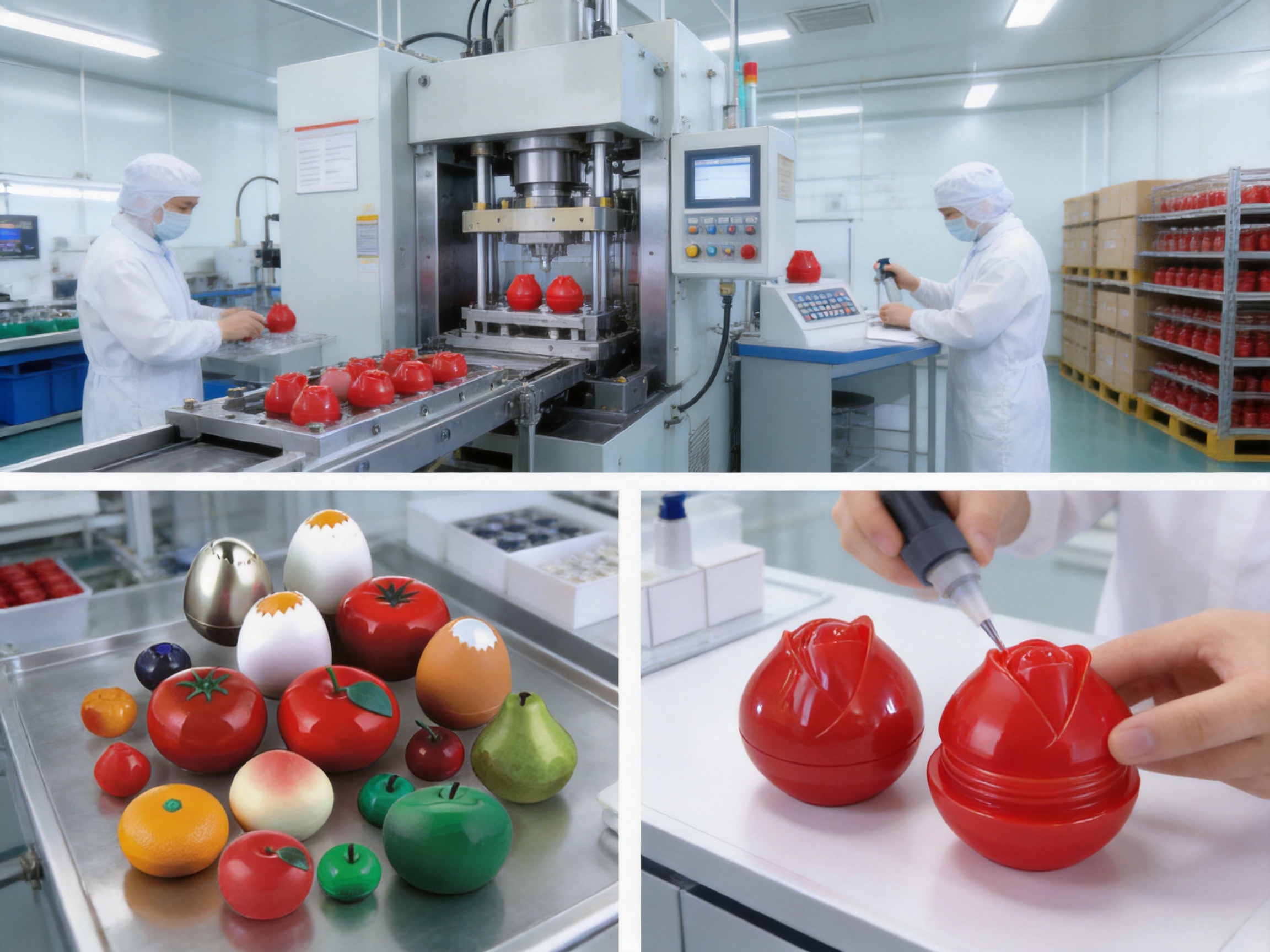
Manufactured by DEPRAG Plastic Products Co., Ltd., the jar is supported by an integrated production system covering product research and development, industrial design, mold manufacturing, plastic injection molding, surface finishing, printing, UV coating, testing, and warehousing. This complete process enables brands to work with one experienced packaging partner from the initial concept through finished production.
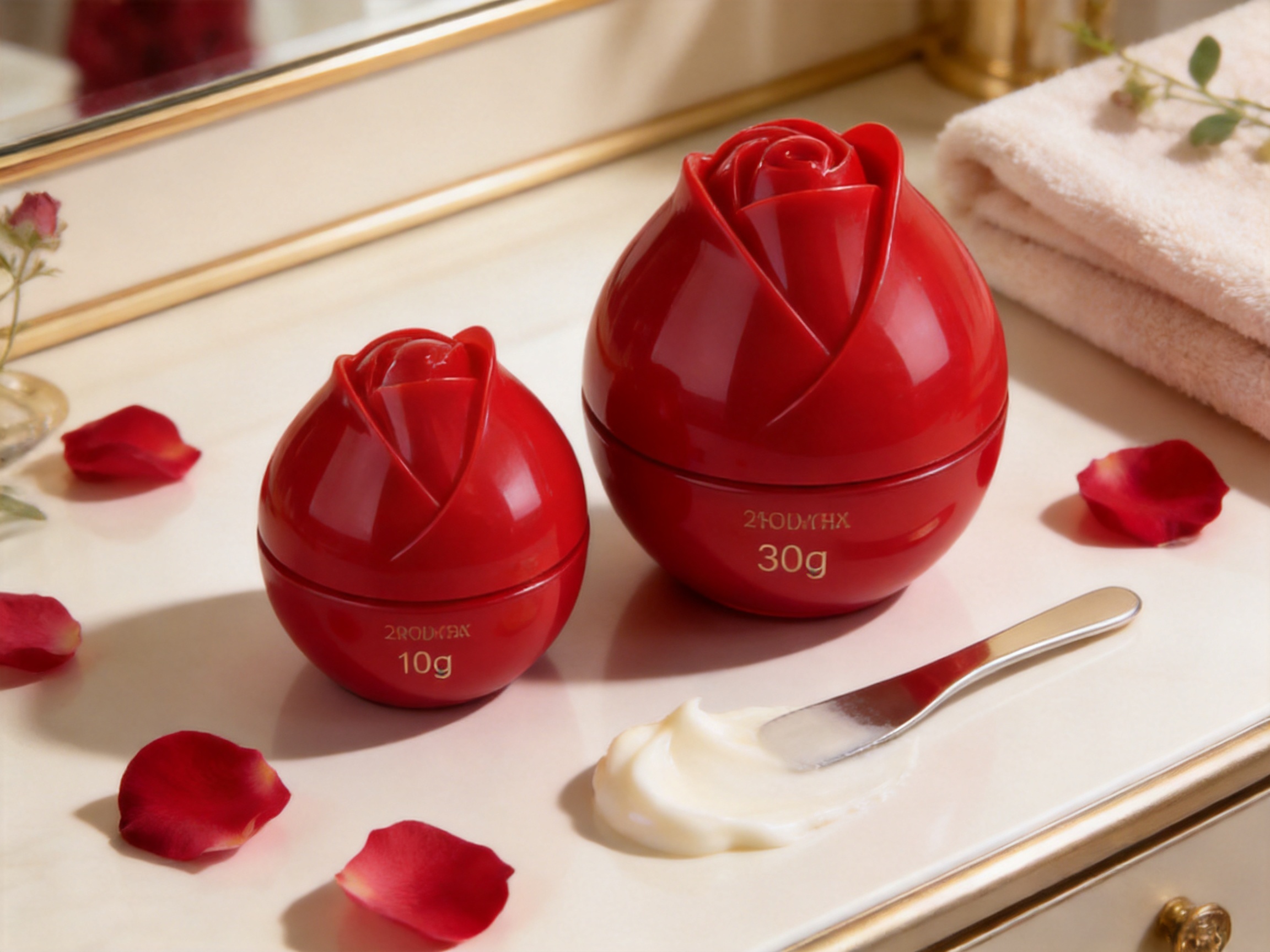
The available 10g and 30g capacities provide practical options for different product strategies. The smaller format can be used for lip masks, eye creams, concentrated treatments, sample-size products, and premium trial kits. The 30g format offers a balanced capacity for face creams, hand creams, overnight masks, and portable skincare products. Together, these sizes allow brands to build coordinated product families while maintaining a consistent visual language.
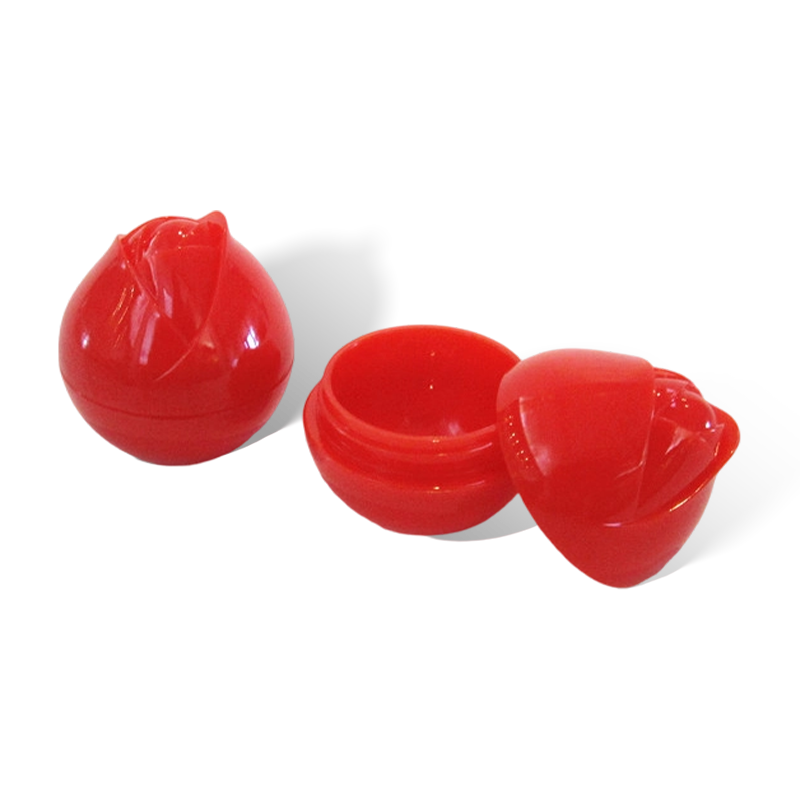
Rose-shaped creative skincare cream jar
Why Creative Packaging Matters in the Modern Skincare Market
The skincare category has become increasingly competitive. New brands, private-label businesses, established cosmetic companies, and specialist treatment lines are all competing for attention in physical stores and digital marketplaces. In this environment, packaging has to perform several roles at once. It must protect the product, support convenient use, reinforce brand positioning, attract attention, and provide an experience that consumers are willing to share and remember.
Traditional packaging formats remain useful, but they can become visually indistinguishable when many competing products use similar jars and bottles. A standard cylindrical cream jar may be practical, yet it often requires additional decoration, complex labeling, or expensive secondary packaging to create a strong identity. A sculptural container can make the primary package itself more distinctive. The rose-shaped jar offers that distinction through its three-dimensional form rather than relying only on printed graphics.
The rose is a widely understood symbol of beauty, love, femininity, celebration, and natural elegance. By translating the rosebud into a functional cosmetic package, the design creates an immediate emotional connection. It can be used for romantic gift collections, bridal skincare, anniversary editions, Valentine’s Day products, women-focused beauty ranges, or premium formulas that emphasize care and indulgence.
Creative packaging also contributes to the ritual of application. When a customer lifts a cap shaped like a flower, opens the jar, and applies the cream, the package becomes part of the daily routine. This sensory sequence can make the product feel more special and encourage stronger emotional attachment. In luxury skincare, these moments are valuable because perceived value is influenced not only by the formula but also by the complete ownership experience.
From Container to Brand Story
A successful package communicates a story quickly. The rose-shaped design suggests that the product is more than a basic moisturizer. It can support narratives centered on renewal, softness, self-care, romance, botanical inspiration, or timeless beauty. A brand may use the form as the foundation for a complete visual system, adding rose-inspired color palettes, floral fragrance themes, botanical ingredients, or seasonal storytelling.
The design can also support product differentiation within a crowded portfolio. A brand that already sells conventional jars may use the rose-shaped container for a hero product, limited-edition formula, premium gift item, or new category launch. Because the shape is inherently recognizable, it can serve as a visual signature across online product listings, social media content, retail displays, and promotional photography.
Key Design Advantage: A 1:1 Simulated Rosebud Appearance
The cap features a multilayered petal structure that recreates the appearance of a rosebud. Rather than applying a flat flower graphic to an ordinary cap, the design uses three-dimensional modeling to express the natural rhythm of rose petals. Smooth lines, gradual curves, and overlapping layers create a more realistic botanical impression.
This biomimetic approach gives the package a strong visual advantage over purely geometric competitors. Conventional packaging often depends on proportion, color, and decoration to stand out. The rose-shaped jar adds a sculptural element that can be recognized from multiple angles. Its silhouette remains distinctive even when a label is small or when the product is displayed among many other items.
The petal-inspired cap is also important from a tactile perspective. The layered form gives consumers something to feel when handling the package. A smooth, carefully finished surface can create a sense of refinement and craftsmanship. In premium cosmetics, tactile quality often influences the customer’s judgment of product value. A package that feels considered and substantial can reinforce the perception that the formula inside is equally valuable.
Visual Recognition Across Sales Channels
Modern cosmetics are promoted through physical retail, brand websites, social platforms, livestream commerce, marketplaces, subscription boxes, and influencer content. Packaging must therefore remain recognizable in different presentation formats. The rose shape can be effective in close-up product photography, short-form video, unboxing content, shelf displays, and gift set arrangements.
On digital platforms, distinctive packaging can improve the visual impact of product thumbnails and campaign images. The cap’s sculptural form creates a clear focal point, while the vivid body color can make the product easier to identify in a scrolling feed. In physical stores, the same qualities may help the product attract attention from a distance and encourage customers to pick it up.
The design also supports user-generated content. Customers may photograph the jar on a vanity, in a handbag, beside flowers, or as part of a self-care routine. A visually expressive package has greater potential to become part of the customer’s lifestyle imagery rather than remaining hidden inside a cabinet.
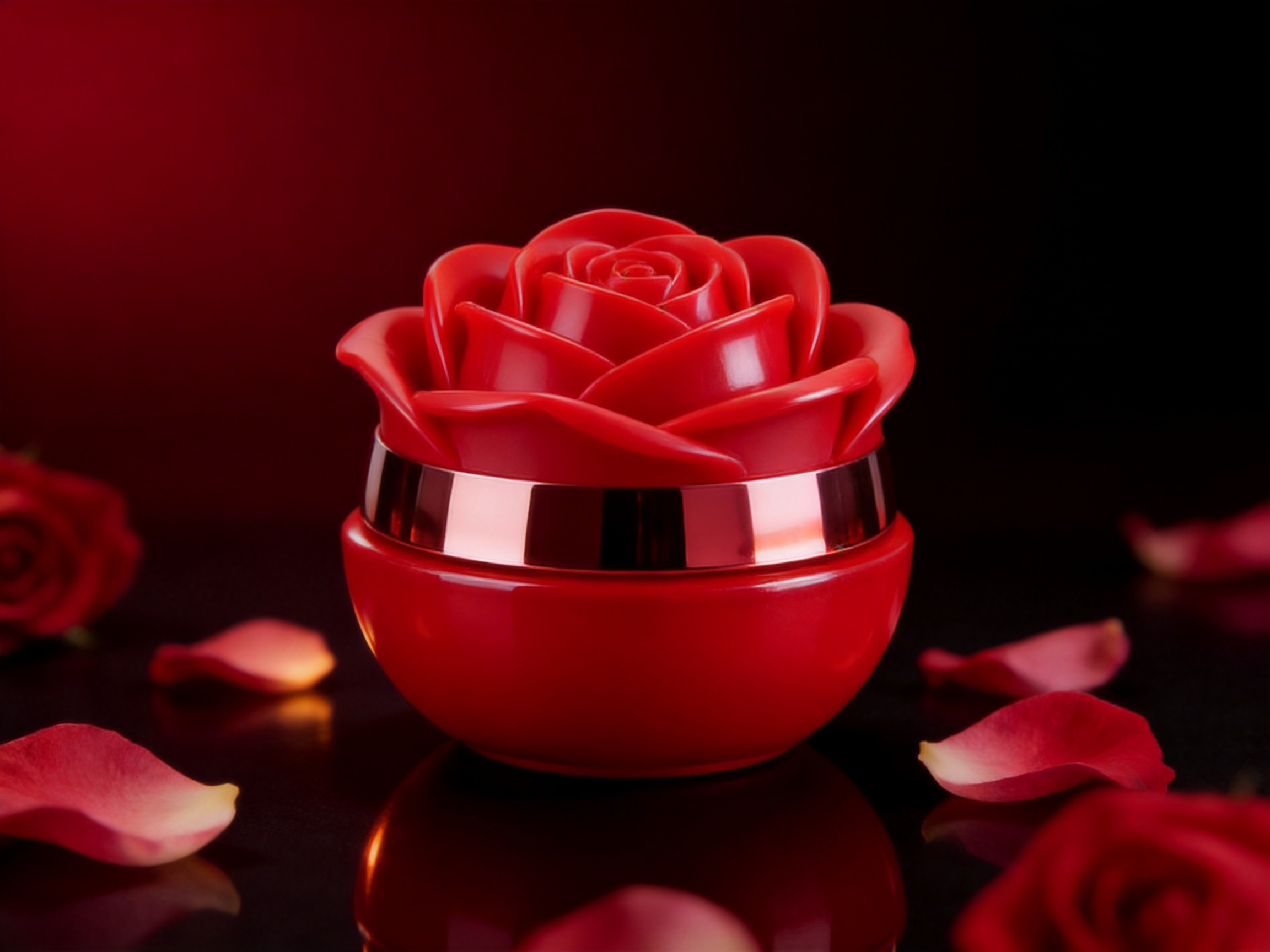
Bright Crimson Mirror Finish for Premium Shelf Appeal
The bottle body uses a bright red spray coating with a smooth, glossy finish. The saturated crimson tone is visually powerful and closely associated with the rich color of a fresh rose. This color and finish combination gives the package immediate presence, especially when positioned within a collection of white, beige, transparent, or pastel cosmetic containers.
A high-gloss red surface can support several premium positioning strategies. It may be used for a luxury anti-aging cream, a festive holiday edition, a romantic gift product, a special collaboration, or a star product intended to attract attention at the center of a skincare collection. The color can also be adapted to brand-specific requirements, depending on the selected decoration and customization program.
The glossy finish does more than add color. It creates highlights across the curved body, emphasizing the package’s rounded profile and making the surface appear polished and refined. When combined with the petal-shaped cap, the finish establishes a contrast between the organic flower-inspired form and the brilliant, contemporary surface treatment.
Benefits of a Coordinated Surface Treatment
Surface treatment is an important part of cosmetic packaging production because it influences both visual quality and brand consistency. Spray coating can help create an even, saturated appearance across the container. When properly controlled, it allows a package to achieve a more specialized appearance than untreated plastic alone.
For a brand, the crimson finish can reduce the need for excessive secondary decoration. The package already carries strong visual impact through its shape and color, allowing labels, logos, and text to remain relatively simple. This can help preserve a clean premium appearance while ensuring that important product information remains legible.
The finish can also be integrated with other decoration techniques, including printing, gilding, and UV coating. For example, a brand may combine the red body with metallic lettering, a contrasting logo, a discreet ingredient statement, or a localized gloss effect. These options allow the same basic jar to serve multiple brand concepts without losing its central design identity.
Compact 10g and 30g Sizes for Flexible Product Planning
Capacity selection has a direct impact on product positioning, distribution, consumer convenience, and cost planning. The rose-shaped cream jar is available in 10g and 30g formats, offering a practical range for premium skincare applications.
| Capacity | Recommended Applications | Primary Advantages | Suitable Product Strategies |
|---|---|---|---|
| 10g | Lip masks, eye creams, intensive treatments, trial products | Compact, portable, giftable, and suitable for sampling | Premium trial kits, travel collections, promotional sets, and limited editions |
| 30g | Face creams, hand creams, overnight masks, and daily treatments | Balanced capacity with strong visual impact | Hero products, boutique skincare lines, gift products, and portable full-use formats |
10g Format: Small Size, High Perceived Value
The 10g size is suitable for products used in small quantities or applied to targeted areas. Eye creams and lip masks are natural applications because consumers typically use only a small amount at each application. It can also be used for concentrated balms, night treatments, rescue creams, or premium samples.
For brands, a compact format provides flexibility in marketing. It may be included in a discovery set, used as a gift-with-purchase item, sold in a multi-piece collection, or offered as a travel-friendly product. A small container with a highly decorative shape can make a sample feel like a genuine premium product rather than a disposable miniature.
The 10g jar is also useful when a brand wants to test a new formula or visual concept before committing to a larger commercial rollout. A limited production run can generate consumer feedback, evaluate market response, and support seasonal campaigns. Its compact dimensions may help simplify portability for customers who carry skincare products in handbags, cosmetic cases, or travel luggage.
30g Format: A Balanced Premium Skincare Option
The 30g version offers more capacity while preserving the distinctive rose-inspired appearance. It is suitable for face creams, hand creams, overnight masks, and other products intended for repeated use. The size is large enough to present the package as a meaningful skincare product while remaining more portable than many conventional full-size jars.
This format can be positioned as a hero item within a creative skincare range. It may be displayed individually as a signature product or combined with the 10g format in a coordinated gift set. The two capacities can share the same color, finish, and decoration, allowing a brand to create visual consistency across different price points and product uses.
Materials and Protection for Skincare Formulas
The jar is made with high-quality plastic materials such as ABS and PP, selected according to the requirements of the packaging structure and intended application. These materials are widely used in cosmetic packaging because they can support attractive shapes, consistent molding, and practical daily handling.
Plastic construction allows designers to create complex forms that may be difficult or expensive to achieve with other materials. The layered rosebud cap depends on accurate molding and controlled dimensional performance. Plastic also offers a useful balance between appearance, weight, impact resistance, and transportation practicality.
ABS may be used where rigidity, surface appearance, and structural strength are important. PP is widely valued for its chemical resistance, lightweight characteristics, and compatibility with cosmetic packaging applications. The final material selection should be confirmed according to the formula, filling process, closure design, decoration requirements, and customer validation procedures.
Light Protection and Chemical Stability
The body’s vibrant coating can help reduce direct light exposure to the container surface. This may be advantageous for skincare products containing ingredients that require careful protection from environmental conditions. Packaging performance must always be evaluated alongside the specific formula, but a colored and coated container can contribute to a more protective packaging system than a fully transparent alternative.
Material stability is another important consideration. Cosmetic formulations may contain oils, emollients, fragrances, active ingredients, preservatives, or other components that interact differently with packaging materials. High-quality plastic selection and compatibility testing help reduce the risk of deformation, discoloration, leakage, or unwanted interaction during storage.
DEPRAG’s production and testing capabilities provide a foundation for evaluating packaging performance. Brands can work with the manufacturer to confirm material suitability and establish testing requirements based on the intended formula and market conditions.
High-Precision Threaded Closure and Sealing Performance
Luxury appearance must be supported by reliable functionality. The rose-shaped cream jar uses a high-precision threaded cap designed to create a secure closure during storage, transportation, and daily use. A properly fitted threaded closure helps reduce the risk of accidental opening, leakage, contamination, and moisture loss.
Sealing is particularly important for skincare products because consumers expect the cream to remain fresh from the first use through the end of the product’s service life. The closure should feel stable when opened and closed, while the threads should provide consistent engagement. A well-controlled screw mechanism also contributes to the perception of quality, as loose or uneven closure performance can undermine an otherwise premium package.
During transportation, packaging may experience vibration, stacking pressure, temperature changes, and repeated handling. A secure closure helps protect the container in distribution environments. For portable products, it is equally important because consumers may carry the jar in a handbag, cosmetic pouch, or travel case.
Supporting Product Freshness
The jar’s closure system is intended to support freshness protection for cosmetic formulas. The exact preservation performance depends on the complete package, including the jar body, cap, liner or sealing components where applicable, filling conditions, formula characteristics, and storage environment.
Brands should conduct appropriate compatibility, leakage, torque, aging, and transportation tests before commercial launch. These evaluations help confirm that the package performs as expected with the selected formulation. DEPRAG’s technical support and product testing capabilities can assist customers in defining a suitable validation process.
Advantages Over Conventional Cosmetic Jars
The rose-shaped container offers several advantages compared with ordinary cosmetic jars. Its most immediate benefit is visual differentiation. A conventional jar may depend on a label or printed decoration to communicate its identity, while the rose-shaped design incorporates brand storytelling directly into the physical structure.
Its second advantage is emotional versatility. The rose symbol can support luxury, romance, natural beauty, femininity, celebration, and gift-giving. A standard geometric package may require more visual explanation to achieve the same emotional effect. The rosebud silhouette creates an intuitive association that can be understood quickly by consumers in different markets.
Its third advantage is campaign flexibility. The same package can be adapted for seasonal promotions, premium launches, wedding collections, anniversary products, and limited-edition programs. The crimson finish provides a strong foundation for festive and romantic campaigns, while alternative decoration options can help reposition the product for other audiences.
Its fourth advantage is content potential. Sculptural packaging is naturally suited to product photography, unboxing videos, social media posts, and retail displays. The container itself becomes a marketing asset, potentially reducing the need for complex visual effects in promotional materials.
Its fifth advantage is size flexibility. The availability of 10g and 30g formats allows brands to create a product ladder. A small format can attract new customers through trial and gifting, while the larger format can serve as the main retail product. This approach supports coordinated merchandising without requiring completely different packaging concepts.
Applications Across Different Skincare Categories
Face Creams
The 30g jar can be used for moisturizing creams, nourishing creams, brightening products, firming treatments, and other facial skincare formulas. Its decorative appearance makes it particularly suitable for products positioned above the mass market. A brand may use the jar for a signature rose cream, a limited-edition treatment, or a formula associated with indulgent nighttime care.
Eye Creams
The compact 10g size is suitable for eye creams and targeted products. The small capacity supports controlled product use and makes the package easy to carry. A premium eye cream in a rose-shaped jar can communicate precision, delicacy, and high value.
Lip Masks and Balms
Lip masks and intensive lip treatments are often sold in small containers because each application requires only a limited quantity. The 10g jar can give such products a more elevated appearance while offering enough capacity for repeated use. Its creative shape may also appeal to customers seeking a decorative addition to their vanity.
Hand Creams
The 30g format can support portable hand cream products designed for handbags, office desks, travel, or gifting. The rose form creates a clear contrast with ordinary squeeze tubes and can help a hand cream occupy a more premium position.
Overnight Masks and Intensive Treatments
Overnight masks and concentrated treatments are often associated with special self-care rituals. The rose-shaped jar reinforces this positioning by making the package feel ceremonial and distinctive. The vivid finish can help these products stand out in a nighttime skincare collection or a holiday gift set.
DEPRAG’s Integrated Manufacturing Capabilities
One of the major strengths behind the product is the manufacturer’s integrated approach to packaging development. DEPRAG Plastic Products Co., Ltd. specializes in packaging containers for cosmetics, medicines, and other plastic products. The company also provides technical support for customers developing professional daily chemical packaging brands.
Its production capabilities cover a wide range of stages, including product research and development, structural design, mold manufacturing, plastic injection molding, blow molding, gilding, printing, UV coating, product testing, and warehousing. Managing these processes within one coordinated manufacturing system can improve communication between design, tooling, production, decoration, and quality control teams.
For customers, integrated manufacturing can reduce the complexity of coordinating multiple suppliers. Instead of commissioning the shape from one company, the mold from another, and surface decoration from a third, brands can discuss the complete packaging requirement with one experienced partner. This may help streamline development schedules, reduce information loss, and make it easier to resolve technical issues.
Product Research and Development
Product research and development is the starting point for transforming a creative idea into a manufacturable package. The rose-shaped jar requires attention to petal geometry, cap assembly, thread design, wall thickness, molding draft, surface finish, and filling compatibility.
An experienced research and development team can evaluate how a visual concept should be adapted for efficient production. The goal is not only to create a beautiful shape but also to ensure that the parts can be molded, assembled, decorated, tested, packed, and transported effectively.
Precision Mold Manufacturing
The quality of a complex cosmetic package depends significantly on mold accuracy. The layered petal design requires careful control of curved surfaces, edges, transitions, and assembly interfaces. A well-made mold helps support consistent replication from one production cycle to the next.
Mold manufacturing also affects the appearance of the finished product. Inaccurate tooling may result in uneven petal details, visible mismatch between components, inconsistent closure performance, or surface defects. DEPRAG’s mold manufacturing capability allows the company to coordinate tooling development with product structure and decoration requirements.
Plastic Injection Molding
Injection molding is well suited to the production of repeatable plastic cosmetic components. Molten plastic is injected into a designed mold, cooled, and removed as a formed part. For a rose-shaped package, process control is important because the cap contains multiple sculptural details and the body must maintain a smooth, attractive surface.
Important production factors include material drying where required, injection temperature, pressure, cooling time, mold temperature, cycle consistency, and part ejection. Proper control helps reduce common defects such as warping, short shots, sink marks, flash, flow lines, and dimensional variation.
Stable injection molding also supports reliable assembly. When the cap, thread, and body are produced within controlled tolerances, the final package is more likely to achieve consistent opening, closing, and sealing performance.
Surface Decoration and Finishing
DEPRAG provides several decoration capabilities, including gilding, printing, and UV coating. These processes allow customers to customize the rose-shaped package for different brand identities and market positions.
Gilding can add metallic accents to logos, borders, names, or decorative details. Printing can provide product information, brand marks, ingredient communication, or graphic elements. UV coating can create localized gloss, enhanced protection, or contrast between different areas of the package.
The bright red spray coating is especially important to the standard visual identity of this product. Surface finishing must be carefully controlled for color consistency, coverage, adhesion, gloss, and overall cleanliness. When decoration and coating are combined effectively, the result can communicate luxury without creating visual clutter.
Quality Control and Production Reliability
Cosmetic packaging quality includes much more than visual appearance. A reliable package must meet requirements for structure, dimensions, closure, surface finish, material suitability, decoration adhesion, cleanliness, and transportation performance.
During production, manufacturers may inspect critical dimensions, part weight, color, surface condition, thread engagement, assembly fit, and leakage performance. The precise inspection program should be established according to the customer’s technical specification and intended market.
For the rose-shaped cream jar, particular attention should be paid to the following areas:
First, the petal structure should be formed consistently so that the cap maintains its intended rosebud appearance. Second, the cap and body should align correctly during assembly. Third, the threaded closure should engage smoothly and provide stable sealing. Fourth, the red coating should remain even across curved surfaces. Fifth, printing or metallic decoration should be positioned accurately and remain firmly attached.
Product testing may include visual inspection, dimensional inspection, closure testing, leakage testing, torque testing, drop or impact evaluation, temperature conditioning, aging studies, and compatibility testing with the final formula. The exact tests depend on the customer’s requirements, product category, distribution conditions, and regulatory obligations.
Customization Opportunities for Brand Development
Although the rose-shaped jar has a strong standard identity, it can serve as a starting point for further customization. Brands may discuss color, coating, decoration, logo treatment, capacity selection, and product application with the manufacturer.
Color customization can help align the container with a brand’s established palette. Crimson is naturally suited to rose-themed and luxury concepts, while other colors may support different product stories. Soft pink may emphasize delicacy, deep burgundy may create a mature premium impression, and pearl or metallic treatments may support festive collections.
Decoration customization can range from a simple logo to more elaborate combinations of printing, gilding, and UV effects. Minimal decoration can preserve the sculptural quality of the package, while carefully placed metallic details can add a more opulent appearance.
Capacity selection allows brands to use the jar across multiple product formats. A 10g package may support sampling and travel, while a 30g package can represent the main retail offering. The two versions can be sold separately or combined into a gift box.
Brands may also explore customized molds when they require a specific structural adjustment or a related floral concept. DEPRAG’s experience with mold manufacturing and plastic product development provides a technical foundation for discussing such projects.
Packaging Strategy for Limited Editions and Gift Sets
The rose-shaped jar is particularly suitable for limited-edition programs. Its distinctive appearance can be matched with seasonal themes such as Valentine’s Day, Mother’s Day, anniversaries, wedding collections, holiday promotions, and exclusive membership gifts.
Limited-edition packaging often needs to create a sense of urgency and collectability. A sculptural rose package can help communicate that the product is special rather than simply repackaged. Brands may combine the jar with a numbered design, special carton, fragrance variation, or coordinated accessory.
Gift sets are another strong application. The 10g and 30g sizes can be placed together in a presentation box, creating a visually coherent set with multiple usage occasions. A 10g eye cream or lip mask can complement a 30g face cream, while the shared rose form creates unity across the collection.
For retail displays, several rose-shaped jars can be arranged together to create a flower-like visual installation. The product’s form supports merchandising concepts that would be difficult to achieve with ordinary rectangular or cylindrical packages.
Logistics, Warehousing, and Commercial Efficiency
Packaging must be attractive at the point of sale, but it must also be manageable throughout the supply chain. DEPRAG provides warehousing support as part of its broader manufacturing process. Coordinated warehousing can help customers manage finished packaging inventory and production scheduling.
The compact format of the jar may support flexible distribution for travel products, gift sets, and boutique retail. However, packaging dimensions, carton design, stacking method, and protective materials should be planned carefully because the sculptural cap may require appropriate spacing to prevent surface damage during transportation.
Commercial efficiency also depends on accurate production planning. Before mass production, brands should confirm the formula, filling method, decoration specification, color standard, inspection requirements, packaging configuration, and delivery schedule. Early technical communication can help reduce changes after tooling or production begins.
Because DEPRAG combines development, mold manufacturing, molding, finishing, testing, and warehousing, customers can discuss these factors as part of one coordinated project. This integrated approach may be especially useful for brands that need support with product launches, private-label development, or custom packaging programs.
How the Rose-Shaped Jar Supports Luxury Positioning
Luxury packaging is not defined by one material or one decoration technique. It is created through the combined effect of design originality, material quality, manufacturing precision, tactile experience, visual consistency, and functional reliability. The rose-shaped jar addresses these factors through its sculptural cap, glossy crimson finish, compact proportions, and secure closure.
The package gives the product a clear point of difference. It can make a skincare formula appear more ceremonial and giftable. It can also help a smaller brand create a premium impression without relying solely on expensive outer packaging.
Luxury positioning must remain credible, however. The package should be supported by a high-quality formula, accurate product claims, clear labeling, appropriate testing, and consistent fulfillment. When the formula and package work together, the rose-shaped jar can become a strong physical representation of the brand’s promise.
Recommended Development Process for Brands
Step One: Define the Product Concept
Brands should first determine the product category, formula type, target consumer, retail price, intended market, and desired positioning. This information helps establish whether the 10g or 30g size is more appropriate and whether the product should be positioned as a sample, treatment, daily cream, gift item, or limited edition.
Step Two: Confirm Material and Compatibility Requirements
The formula should be reviewed for compatibility with the proposed ABS, PP, coating, and closure components. Testing should consider the formulation’s oils, fragrances, active ingredients, pH, preservatives, and storage conditions.
Step Three: Select Decoration and Color
The brand should confirm the preferred color, gloss level, logo treatment, printing method, metallic decoration, and UV effects. A physical sample or approved color standard can help improve consistency during production.
Step Four: Review Samples and Tooling
Samples should be evaluated for appearance, dimensions, assembly, thread performance, tactile quality, and overall brand fit. If a customized mold is required, the structure should be reviewed carefully before tooling is finalized.
Step Five: Conduct Testing
Testing should include formula compatibility, leakage, closure performance, transportation simulation, aging, and decoration adhesion as appropriate. Any issues should be addressed before mass production.
Step Six: Plan Production and Delivery
Once the design and testing are approved, the brand and manufacturer can confirm order quantities, production timing, inspection standards, packaging configuration, warehousing, and shipping arrangements.
Q&A: Rose-Shaped Creative Skincare Cream Jar
Q1: What makes this cream jar different from a conventional cosmetic jar?
The main difference is its three-dimensional rosebud design. The layered petal cap creates a distinctive sculptural appearance instead of relying only on labels or printed graphics. The jar also combines this creative form with a bright crimson glossy finish and a secure threaded closure.
Q2: Which product categories are suitable for the jar?
The jar is suitable for face creams, eye creams, lip masks, hand creams, overnight masks, intensive treatments, trial products, and other skincare formulas. The 10g size is especially appropriate for targeted products and samples, while the 30g size is suitable for face creams and portable full-use products.
Q3: What capacities are available?
The standard capacities are 10g and 30g. The smaller size supports trial, travel, gifting, and targeted skincare applications. The larger size offers a balanced option for daily or repeated-use products.
Q4: Is the jar suitable for luxury cosmetic brands?
Yes. The sculptural rosebud form, saturated red coating, smooth glossy surface, and premium decoration options make it suitable for luxury skincare, limited editions, gift sets, and high-value treatment products.
Q5: What materials are used?
The packaging can be produced using high-quality plastics such as ABS and PP, depending on the structural requirements, formula compatibility, decoration process, and customer specification. Final material selection should be confirmed through technical evaluation and compatibility testing.
Q6: Does the threaded cap help prevent leakage?
The high-precision threaded cap is designed to provide secure closure and support sealing during storage, carrying, and transport. The complete package should still undergo appropriate leakage and compatibility tests with the customer’s formula before commercial use.
Q7: Can the color or decoration be customized?
Brands can discuss color, spray coating, printing, gilding, UV coating, logo treatment, and other decoration requirements with the manufacturer. Customization should be evaluated according to the desired appearance, order quantity, technical feasibility, and production schedule.
Q8: Is the package suitable for gift sets?
Yes. The decorative rose form makes the jar suitable for gift collections, romantic campaigns, holiday editions, bridal products, anniversary products, and coordinated skincare sets. The 10g and 30g formats can be combined to create a product hierarchy within one collection.
Q9: What manufacturing services are available?
DEPRAG provides product research and development, design, mold manufacturing, injection molding, blow molding, gilding, printing, UV coating, product testing, warehousing, and related technical support. This allows customers to coordinate multiple packaging requirements through one manufacturing partner.
Q10: Why is mold quality important for this design?
The rosebud cap contains multiple curved petal layers and detailed transitions. Accurate tooling helps maintain consistent shape, smooth surfaces, reliable assembly, and repeatable production quality. Mold precision is particularly important when the package depends on three-dimensional visual detail.
Q11: Can the jar be used for private-label skincare?
Yes. Its distinctive structure can help private-label brands create a recognizable product concept without developing a completely new package from the beginning. Brands can combine the standard form with customized color, decoration, formula, labeling, and gift packaging.
Q12: What should a brand confirm before placing a production order?
The brand should confirm the formula, capacity, material, color, surface finish, decoration, logo artwork, closure requirements, testing standards, order quantity, delivery schedule, and packaging configuration. Technical samples should be reviewed and approved before mass production.
Why Partner with an Experienced Packaging Manufacturer
Creative packaging development requires more than an attractive drawing. The design must be translated into a moldable structure, produced consistently, decorated accurately, tested thoroughly, and delivered according to a commercial schedule. An experienced manufacturer helps connect these stages.
DEPRAG is located in Cixi, China, an area known for its developed plastic industry. The company benefits from convenient transportation links, including proximity to the Hangzhou Bay Bridge, Ningbo’s Beilun deep-water port, and Hangzhou Xiaoshan International Airport. This location can support access to manufacturing resources and facilitate domestic and international logistics planning.
The company operates with experienced research and development personnel, advanced manufacturing equipment, and modern standardized factories. Its product range includes thousands of daily chemical packaging designs, as well as customized mold development. This combination allows customers to select from established packaging concepts while retaining the option to develop more specialized solutions.
DEPRAG’s approach emphasizes technical support and long-term business relationships. For brands, this means packaging can be treated as an ongoing product development partnership rather than a one-time purchase. The manufacturer’s stated business philosophy is that customer success contributes directly to DEPRAG’s success.
Conclusion
The rose-shaped creative skincare cream jar offers a strong combination of emotional design, premium appearance, compact functionality, and manufacturing flexibility. Its multilayered petal cap creates a recognizable rosebud silhouette that can differentiate skincare products from conventional geometric containers. Its bright crimson mirror finish delivers immediate shelf impact and supports luxury, romantic, festive, and limited-edition positioning.
The availability of 10g and 30g sizes gives brands practical options for eye creams, lip masks, samples, face creams, hand creams, overnight masks, and gift sets. High-quality ABS or PP construction, light-protective coloration, chemical stability, and a high-precision threaded closure support the functional requirements of modern skincare packaging.
Behind the design is an integrated manufacturing system that includes research and development, product design, mold manufacturing, injection molding, surface coating, printing, gilding, UV finishing, testing, and warehousing. This complete capability can help brands simplify supplier coordination, improve development communication, and build packaging programs with greater consistency.
For cosmetic companies seeking a package that functions as both a protective container and a visual statement, the rose-shaped jar provides a compelling solution. It transforms the skincare package into an object of beauty, supports memorable consumer experiences, and gives brands a flexible platform for premium product development.
References
1. Cosmetic Packaging Design Principles, industry guidance on visual differentiation, user experience, and product positioning.
2. Plastic Materials for Cosmetic Containers, technical reference covering ABS, PP, chemical resistance, molding behavior, and packaging applications.
3. Injection Molding Process Control, manufacturing reference on tooling accuracy, dimensional stability, cooling, cycle consistency, and defect prevention.
4. Packaging Compatibility Testing for Personal Care Formulas, technical guidance on material interaction, aging, leakage, and storage evaluation.
5. Surface Decoration Methods for Cosmetic Packaging, reference covering spray coating, printing, gilding, UV coating, gloss control, and adhesion testing.
6. Sustainable Product Development and Packaging Optimization, industry reference on material efficiency, product longevity, transport planning, and responsible packaging design.
7. DEPRAG Plastic Products Co., Ltd. Product and Manufacturing Information, company-provided materials concerning cosmetic packaging development, production capabilities, testing, warehousing, and technical support.
Product: Rose-shaped creative skincare cream jar

-
 DP-A-021 50g/30g/20g Skin Whitening Cream Packaging Cosmetic Jars
-
 DP-A-009 Body Cream Jar 80ml Container 70ml Cosmetic Packaging Body Butter Plastic Jar
-
 10g Luxury Creative Cherry-Shaped Face Cream Jar
-
 DP-A-020 120ml Green Acrylic Cream Bottle 50g Blue Acrylic Cosmetic Container 50ml Acrylic Jar and Bottles
-
 Gold 200ml/100ml/50ml/30ml Empty Arabic Dubai Glass Luxury Perfume Bottles
-
 Luxury 100ml Round Perfume Bottle
- +86 13968274500
- +86 13764345885
- ysgl@vip.163.com
- No. 10-18, Gaoxiakeng, Dongputou Village, Zhangqi Town