English
 中文简体
 Français
 Español
 عربى



Luxury Round Glass Perfume Bottles for Premium Fragrance Brands
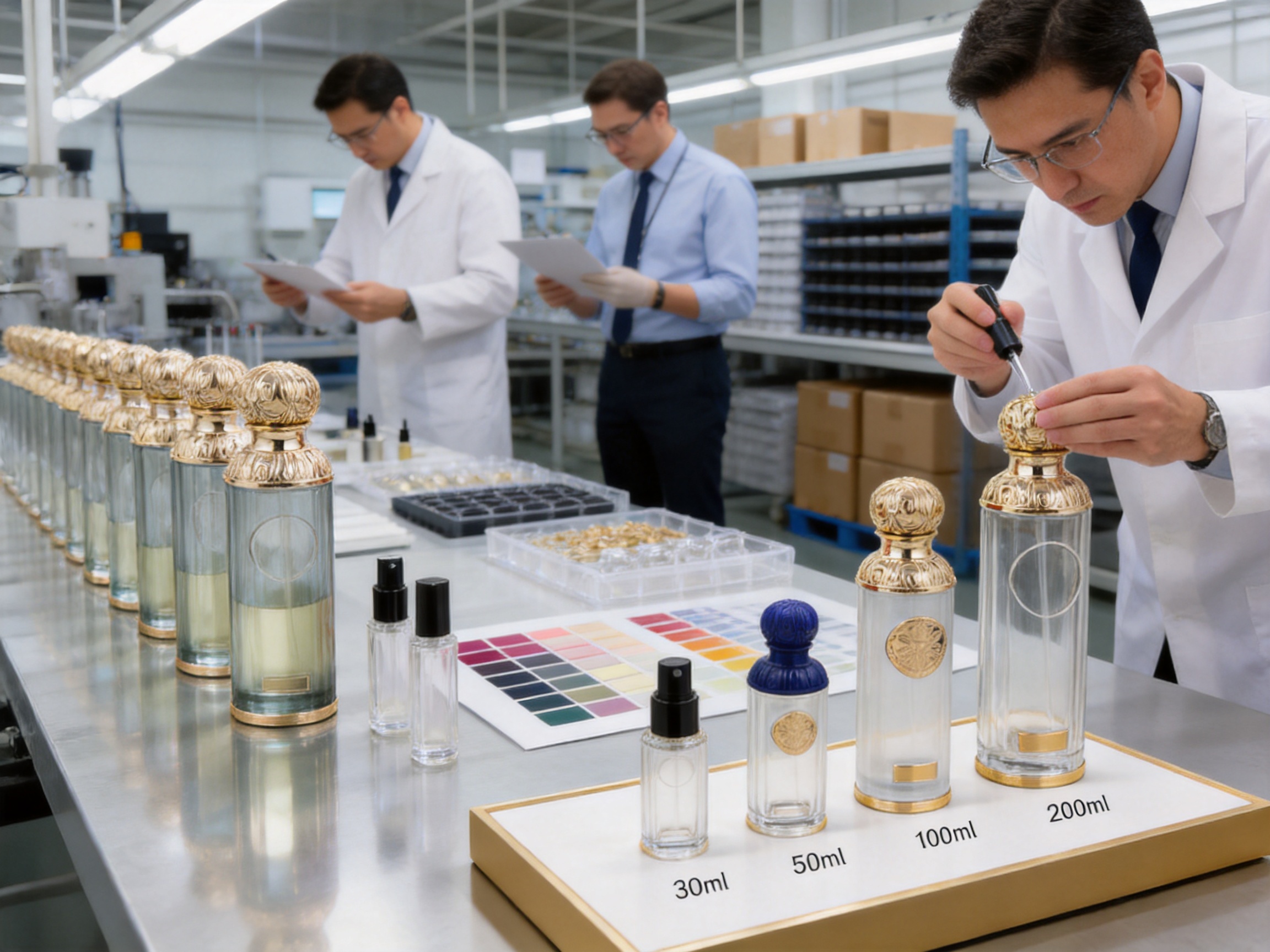
Packaging is one of the most important expressions of a fragrance brand. Before a customer experiences the scent, the bottle communicates quality, personality, positioning, and value. A well-designed perfume bottle can transform a fragrance from an ordinary personal-care product into a memorable luxury object. The 30ml, 50ml, 100ml, and larger-capacity round empty glass perfume bottle series is designed for brands that want to combine classical elegance, modern customization, and dependable manufacturing performance in one packaging solution.
Inspired by classical palace architecture and ceremonial scepters, this perfume bottle series presents a refined cylindrical body with a sculpted spherical cap. The overall design balances strength and movement: the straight bottle structure conveys stability, while the dimensional cap introduces visual drama and decorative richness. This combination gives the packaging a prestigious appearance suitable for premium perfumes, niche fragrances, collector’s editions, gift sets, and selected body sprays.
For fragrance companies, packaging must do more than hold liquid. It must protect the formula, create a positive user experience, support visual branding, withstand supply-chain handling, and provide enough flexibility for different market segments. This series addresses these requirements through multiple capacities, surface treatments, color options, decorative possibilities, and a fine-mist spray system.
Product Overview
The product is an empty glass perfume bottle supplied for filling, branding, and final assembly by fragrance manufacturers, private-label companies, cosmetic brands, and distributors. Its classic round profile gives it a broad visual appeal, while the sculpted cap and central decoration area help it stand apart from conventional cylindrical fragrance bottles.
The standard capacity range includes 30ml, 50ml, and 100ml options, with a broader capacity matrix also available for projects requiring 200ml packaging. This range allows one design language to support multiple product strategies. A 30ml format can be used for travel fragrances, trial editions, promotional sets, and compact retail products. A 50ml bottle is suitable for a balanced everyday fragrance offering. A 100ml bottle provides the familiar full-size format expected in many premium fragrance collections. A 200ml option can serve large-capacity products, body sprays, home fragrance-related concepts, or special gift editions where a stronger shelf presence is required.
The bottle is categorized as perfume packaging and is suitable for a variety of fragrance applications. Depending on the filling formula, closure configuration, decoration, and final compatibility testing, it can be developed for eau de parfum, eau de toilette, body mist, premium fragrance oils, and other liquid fragrance products.
| Feature | Available or Applicable Option | Branding Benefit |
|---|---|---|
| Capacity | 30ml, 50ml, 100ml, and selected 200ml formats | Supports travel, standard, premium, and large-capacity product lines |
| Bottle structure | Classic cylindrical glass body | Creates a stable, recognizable, and versatile silhouette |
| Cap design | Three-dimensional spherical relief cap | Provides a strong luxury cue and visual differentiation |
| Decoration area | Central circular recess or flat surface | Allows logo plaques, emblems, labels, or silkscreen printing |
| Color directions | Crystal white, gradient green, coated colors, and matte finishes | Helps brands create different collections and market positions |
| Spray system | Built-in pump nozzle with fine atomization | Supports a controlled, pleasant, and consistent fragrance experience |
| Applications | Perfumes, niche fragrances, gift sets, collector’s editions, and body sprays | Offers flexibility across multiple fragrance categories |
Design Inspired by Classical Luxury
The design concept draws from two recognizable symbols of prestige: palace architecture and royal scepters. Palace architecture is associated with proportion, symmetry, permanence, and ornamentation. A scepter represents authority, ceremony, and distinction. These references have been translated into a bottle that looks decorative without becoming impractical for everyday use.
The cylindrical glass body provides a clean architectural foundation. Its regular shape is easy to display, easy to arrange in retail collections, and suitable for a wide range of label and decoration treatments. Unlike highly irregular bottle shapes that can be difficult to store or align on shelves, the round body offers a controlled and balanced appearance. It also makes it easier for a fragrance brand to develop a consistent family of products in multiple capacities.
The spherical cap is the primary visual statement. Its three-dimensional relief surface gives the package depth and texture, creating a stronger impression than a simple smooth cap. The raised ornamental pattern can suggest Baroque richness, classical craftsmanship, or a heritage-inspired brand story. When paired with a metallic or saturated color treatment, the cap becomes a recognizable signature element that customers can associate with the fragrance collection.
This design approach offers an advantage over generic bottles that rely only on printed labels for differentiation. In a crowded fragrance market, a memorable cap can function as a visual logo. It can be identified from a distance, photographed effectively for online retail, and used as part of the brand’s broader visual language across advertising, social media, and gift packaging.
The bottle’s balance between classical and contemporary styling also broadens its target audience. It can appeal to customers who enjoy traditional luxury, while the clean cylindrical form and modern finishing options keep the design relevant to current fragrance trends. The same basic structure can be interpreted as elegant, dramatic, masculine, feminine, unisex, vintage-inspired, or contemporary depending on the selected color, coating, decoration, and fragrance concept.
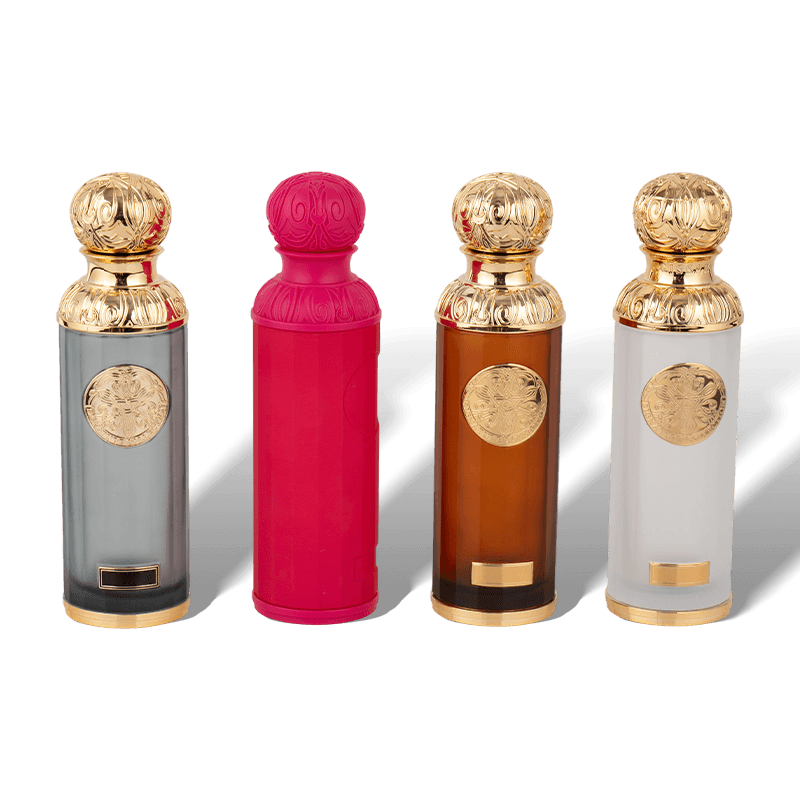
30ml/50ml/100ml round empty glass perfume bottle
Exquisite Relief Cap Construction
The relief cap is one of the product’s strongest differentiating features. A cap is often treated as a secondary component, but in premium fragrance packaging it can be as important as the bottle itself. This cap is designed with a dimensional ornamental surface that creates highlights and shadows as the product moves under retail lighting.
The sculpted relief pattern is intended to communicate a high level of craftsmanship. Detailed raised elements can visually suggest hand-finished ornamentation, architectural molding, or ceremonial metalwork. The result is a cap with a richer tactile and visual character than a standard injection-molded smooth closure.
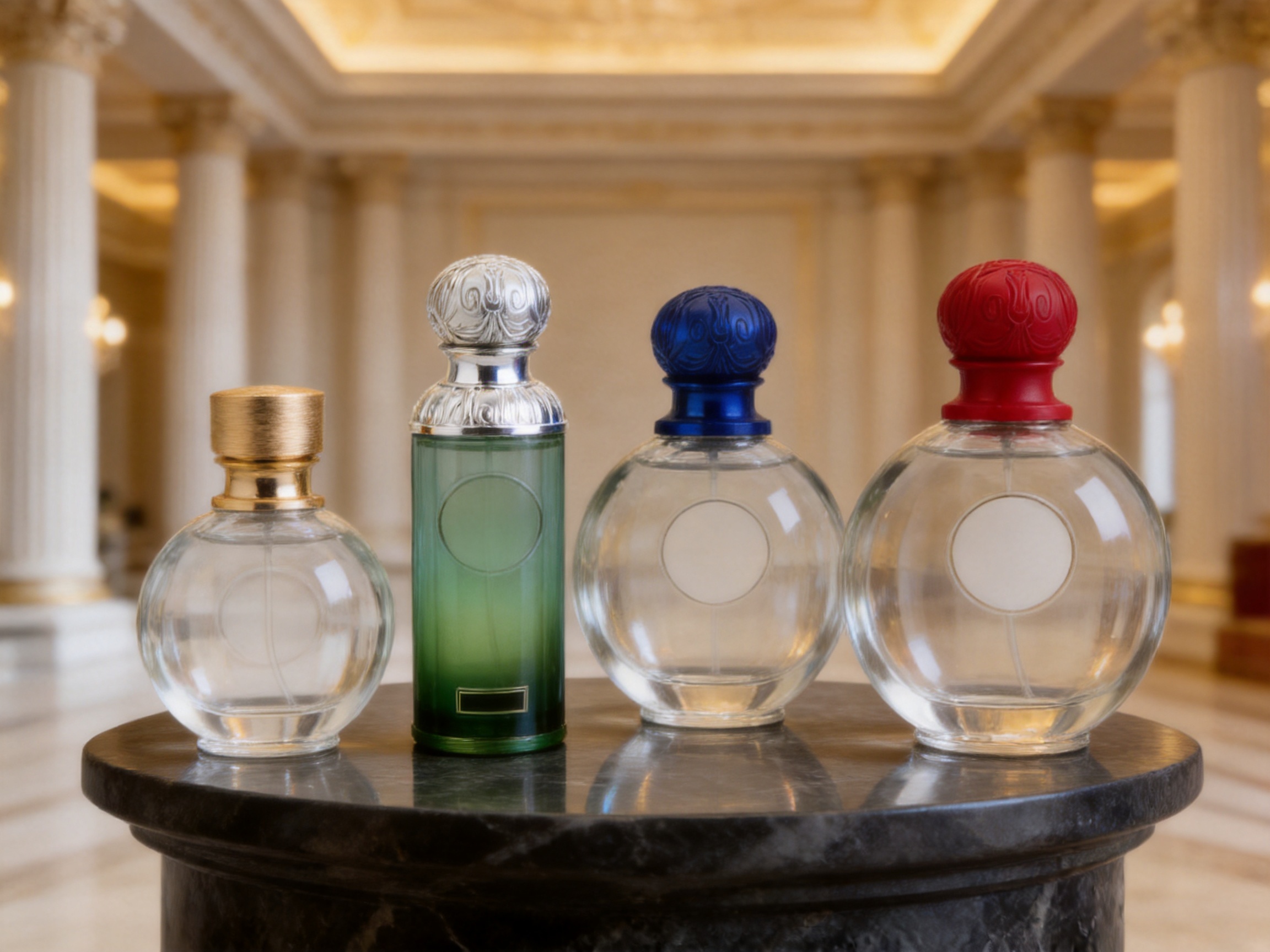
Several color directions are available for different brand identities. Brushed gold can emphasize warmth, heritage, and traditional luxury. Bright silver can create a cooler, cleaner, and more contemporary appearance. Sapphire blue can support a sophisticated, mysterious, or evening-oriented fragrance concept. Matte red can produce a confident and energetic presentation suitable for bold collections or limited editions.
The cap color does more than decorate the bottle. It can help separate fragrance variants within a collection. For example, a brand may use gold for an oriental fragrance, silver for a fresh fragrance, blue for a night fragrance, and red for an intense or limited-edition version. A consistent bottle silhouette combined with differentiated cap colors allows customers to understand that the products belong to one family while still recognizing their individual identities.
The relief cap also contributes to the unboxing experience. When a customer lifts the cap, the raised ornamentation creates a tactile moment that reinforces the perception of value. Premium packaging is often judged through multiple senses, including sight, touch, sound, and ease of use. A carefully designed cap can make the first interaction with the fragrance more memorable and support a stronger emotional connection with the product.
Central Area for Brand Emblems and Custom Decoration
The bottle includes a specially designed circular recess or flat area at the center of the body. This feature gives fragrance brands a dedicated location for visual identification. The area can be used for a luxury logo plaque, a metal emblem, a printed medallion, a silkscreened mark, or another approved decorative treatment.
This central placement is particularly valuable for brands that want to emphasize an emblem rather than a large conventional label. A circular logo plaque can create the impression of a seal, crest, coin, or royal insignia. It is well suited to heritage brands, niche perfume houses, private-label collections, and limited-edition releases that depend on a strong symbolic identity.
The decoration area can also simplify the development of multiple fragrance variants. A brand may retain the same bottle and emblem position while changing the logo color, plaque material, fragrance name, or surrounding finish. This creates a coordinated product family and reduces the need to develop an entirely new bottle shape for every fragrance.
For brands seeking a more understated appearance, the area can accommodate a discreet printed mark. For brands seeking stronger shelf impact, it can become the foundation for a raised emblem, metallic plaque, or contrasting decorative panel. This flexibility helps the bottle serve both minimalist and highly ornamental visual strategies.
Before mass production, the chosen decoration method should be reviewed through sampling and compatibility testing. Factors such as adhesion, abrasion resistance, chemical exposure, curing conditions, color consistency, and packaging transport should be evaluated. DEPRAG Plastic Products Co., Ltd. can provide technical support during the development process, helping customers coordinate bottle structure, decoration, finishing, and production requirements.
Glass Body Advantages for Fragrance Packaging
Glass remains a preferred material for many premium perfume applications because it combines visual clarity, substantial hand feel, chemical resistance, and strong decorative potential. The transparent or coated glass body allows the fragrance package to appear refined and substantial while giving brands many options for color and surface treatment.
The cylindrical glass structure is especially practical for premium packaging programs. Its proportions can create a solid and stable hand feel without relying on excessive external ornamentation. The shape is also adaptable to transparent, translucent, coated, frosted, gradient, and matte visual effects.
Crystal white or clear glass can be used when the fragrance itself is part of the visual story. A lightly colored or transparent formula can be displayed as a symbol of purity, freshness, or simplicity. This direction is suitable for clean fragrances, botanical concepts, modern unisex collections, and brands that want the liquid to remain visible.
Gradient green or coated green finishes can create a deeper and more sophisticated appearance. When combined with a metal-look base or coordinated cap, the bottle may evoke emerald tones, botanical richness, or a premium natural concept. Green is also flexible enough to support masculine, feminine, and unisex fragrance positioning.
Full matte finishing provides a soft visual impression and a more tactile surface experience. A matte bottle can appear contemporary, restrained, and fashion-oriented. It can also reduce visual reflections, helping printed information or decorative elements stand out more clearly. The velvet-like touch associated with a matte finish can strengthen the sense that the product is designed for a premium consumer experience.
Compared with lightweight or low-cost plastic alternatives, a glass bottle can provide greater perceived value in fragrance categories where weight and transparency influence purchase decisions. Plastic packaging may be appropriate for specific travel or mass-market applications, but glass remains highly competitive for luxury fragrance presentation, collector’s editions, and products where the bottle is expected to remain as a decorative object after use.
Color and Surface-Finish Options
A major advantage of this bottle series is the ability to adapt the same basic design to different visual identities. Color and finish selection should be considered together with the fragrance formula, target customer, retail environment, and planned product price.
Crystal White and Clear Presentation
A crystal-white or clear presentation places emphasis on purity and transparency. It can help customers see the liquid and understand its color before opening the package. This treatment is suitable for fresh, aquatic, floral, citrus, and minimalist fragrances. It may also support brands that use clean typography, white-space design, or simple natural imagery.
Clear presentation is especially effective when the fragrance liquid has a subtle tint. Pale rose, amber, champagne, or light green formulas can become part of the overall color story. A transparent body can also be paired with a metallic relief cap to create contrast between the visible liquid and the decorative closure.
Gradient Green and Coated Colors
Gradient finishing gives the body greater depth and helps the package appear more dimensional. A green gradient can move from a lighter tone near the shoulder to a deeper tone toward the base, or it can be adapted according to the brand’s design requirements. This effect can suggest emerald, forest, botanical, or nocturnal themes.
Coated colors provide a broader creative range than transparent glass alone. Depending on the approved finish, brands may develop colors that match an existing identity system or coordinate with secondary packaging such as cartons, gift boxes, and display trays. Color matching should be confirmed through physical samples because visual results can vary according to glass thickness, coating method, lighting, and viewing angle.
Full Matte Finish
A full matte finish creates a soft, modern appearance. It is useful for products positioned as contemporary, understated, artistic, or fashion-led. Matte surfaces can also provide contrast against glossy printed marks, metallic plaques, or polished cap details.
The tactile quality of a matte finish is important in a premium package. Customers often handle the bottle before purchasing, especially in department stores, specialty fragrance shops, and gift-oriented retail environments. A smooth matte surface can make the bottle feel more carefully considered and can distinguish it from ordinary glossy packaging.
Fine-Mist Spray Experience
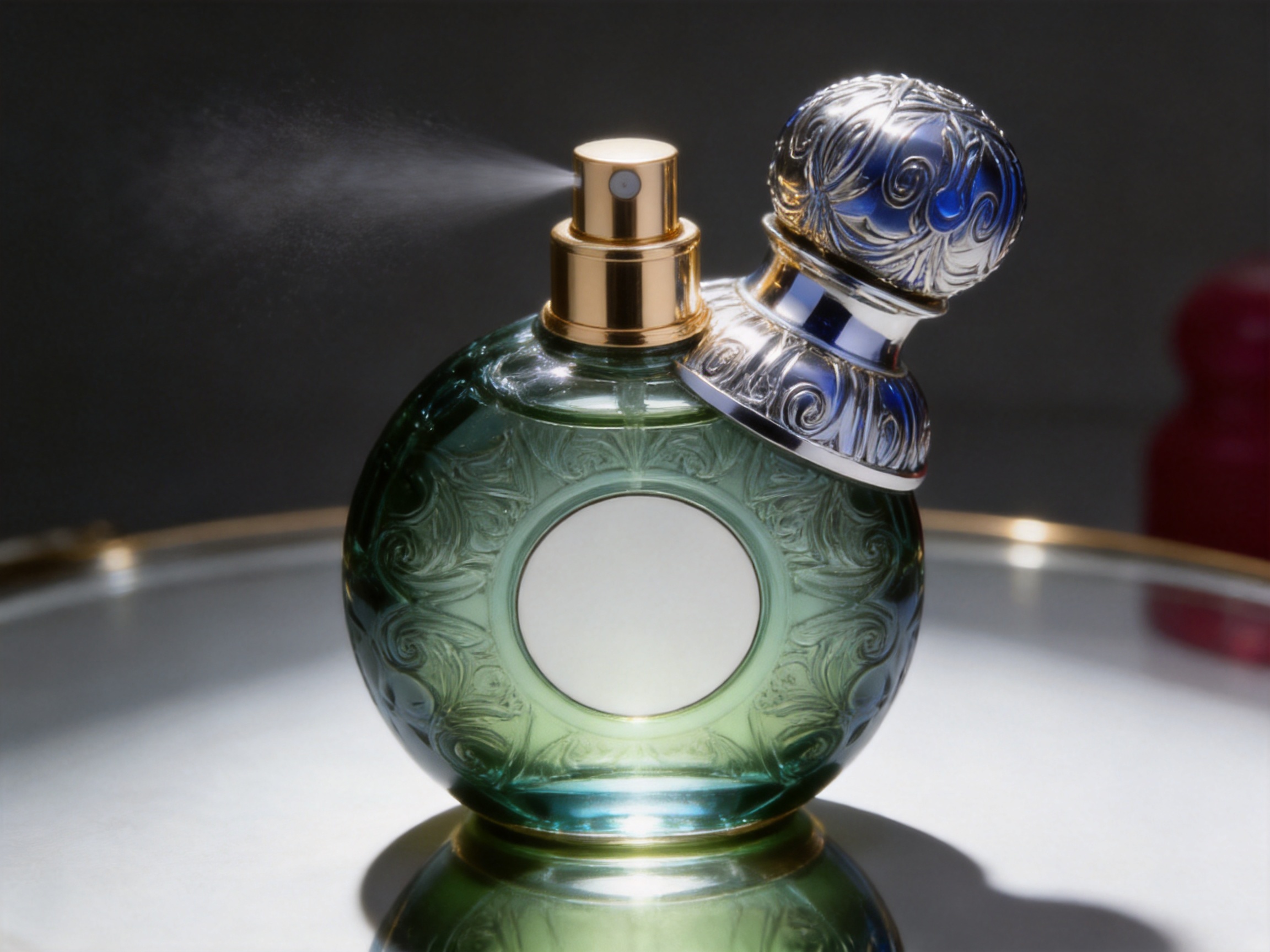
A perfume bottle must deliver a satisfying application experience as well as an attractive appearance. The product is equipped with a high-quality built-in pump nozzle designed to atomize fragrance into a wide and fine mist. Fine atomization helps distribute the fragrance more evenly and can make the application feel lighter and more refined.
The spray mechanism is an important part of the customer’s perception of quality. A pump that produces an inconsistent stream, excessive droplets, or an uneven spray pattern can reduce confidence in the entire product. By contrast, a reliable fine-mist output supports controlled application and reinforces the premium positioning of the fragrance.
A broad mist can be useful when applying fragrance to the wrist, neck, clothing, or surrounding air, depending on the formula and usage instructions. The consumer can achieve coverage without pressing the pump repeatedly. The precise spray experience can also contribute to more efficient product use by helping release a measured amount of liquid with each actuation.
Before final production, brands should conduct formula compatibility testing with the pump, dip tube, gasket, crimping or assembly method, and bottle finish. Fragrance compositions may contain alcohol, essential oils, solvents, colorants, or other ingredients that can interact differently with packaging components. Testing should assess leakage, spray performance, odor transfer, discoloration, corrosion, seal integrity, and long-term storage behavior.
DEPRAG’s technical support and manufacturing capabilities can assist customers in coordinating packaging development with filling and assembly requirements. The purpose is to ensure that visual design and functional performance are developed together rather than treated as separate stages.
Capacity Options for Different Market Strategies
The availability of multiple capacities allows brands to build a broader portfolio around one recognizable package design. This is a practical advantage for companies that want product consistency across retail channels.
30ml Travel and Trial Format
The 30ml bottle is suitable for travel collections, discovery programs, seasonal promotions, and customers who prefer a compact fragrance format. It can be used as a standalone product or included in a gift set with other sizes. A smaller format may also reduce the customer’s initial purchase commitment, making it useful for emerging brands and new fragrance launches.
For travel retail and online sales, a compact bottle can offer convenient handling and efficient presentation. It may appeal to customers who want to carry a fragrance in a handbag, work bag, or luggage. Brands can also use the 30ml size to create entry-level products while maintaining the same premium design language as larger versions.
50ml Everyday Premium Format
The 50ml size provides a balance between product volume, portability, and shelf presence. It can serve as a central format for an everyday premium fragrance line. Many consumers view this capacity as large enough for regular use while still being convenient for travel and gifting.
For a growing fragrance brand, the 50ml format can be used as the main commercial size, with 30ml and 100ml versions added later as the collection expands. The shared bottle design helps the products appear coordinated in e-commerce photography and physical retail displays.
100ml Full-Size Format
The 100ml bottle creates a stronger full-size presence and is well suited to established fragrance products, premium launches, and signature scents. Its larger body gives the design more visual authority and provides additional space for a central emblem or decorative treatment.
Many customers associate a 100ml bottle with a complete fragrance experience and long-term value. It is suitable for hero products that need to occupy a prominent position in a brand’s collection. The relief cap can be especially effective at this size because the overall package has enough scale to display the relationship between the cylindrical body and the sculpted closure.
200ml Large-Capacity Format
The 200ml option can support large-capacity body sprays, special editions, promotional products, and products designed for frequent or generous use. It may also be selected for gift-oriented packaging or markets where larger fragrance volumes are preferred.
Large-capacity packaging requires particular attention to stability, transport protection, closure performance, filling operations, and secondary packaging. These technical factors should be confirmed during project development. The benefit is a distinctive package that extends the design system into a larger and more visually prominent format.
Applications Across Premium Fragrance Categories
The bottle series is appropriate for modern men and women seeking premium fragrances, niche perfumes, and collector’s-edition gift sets. Its adaptable appearance makes it suitable for a variety of brand stories.
For a heritage fragrance brand, the relief cap and central emblem area can reinforce ideas of tradition, craftsmanship, and institutional prestige. For a niche perfume house, the same structure can provide a distinctive base for unusual colors, artistic plaques, or limited-edition graphics. For a contemporary unisex brand, a clear or matte bottle with a restrained emblem can create an architectural and gender-neutral appearance.
The package can also support seasonal collections. A brand may use a bright metallic cap and clear body for a spring fragrance, a deep green coated body for an autumn edition, and a dark or saturated finish for an evening fragrance. Because the silhouette remains consistent, seasonal variation can occur without sacrificing brand recognition.
Collector’s editions can make fuller use of the decorative cap and emblem area. A numbered plaque, special color, commemorative mark, or gift-box insert can turn the bottle into a keepsake. The packaging may remain on a customer’s dressing table or display shelf after the fragrance has been used, extending the brand experience beyond the initial purchase.
Gift sets are another suitable application. Different capacities can be combined with matching cartons, fragrance samples, body products, or accessories. The rounded bottle shape and ornamental cap can create an attractive centerpiece within a presentation box. For corporate gifting and seasonal retail campaigns, the bottle can be paired with a custom sleeve, ribbon system, or rigid box developed around its dimensions.
Advantages Over Generic Competitor Packaging
In a competitive fragrance market, product differentiation often depends on details that appear small but have a significant cumulative effect. This bottle series offers several advantages compared with standard empty perfume bottles.
Stronger Shelf Recognition
The combination of a cylindrical body and sculpted spherical cap creates a recognizable outline. Generic bottles may rely on common rectangular, oval, or smooth cylindrical shapes that look similar to competing products. The relief cap gives this series a distinctive upper profile that can attract attention in retail displays and online product images.
More Effective Luxury Communication
Luxury positioning is communicated through proportion, weight, surface quality, detail, color, and finishing. The dimensional cap, central emblem area, and available metallic or matte treatments provide multiple premium cues. Instead of depending only on a printed label, the package expresses quality through its physical form.
Greater Collection Flexibility
The multiple capacity options and adaptable finishes allow brands to develop a coordinated product family. A competitor’s bottle may be attractive for one fragrance but difficult to extend into other sizes or variants. This series is designed as a broader matrix, enabling travel, standard, full-size, and large-capacity products to share a visual identity.
Better Customization Potential
The central circular area provides a planned location for branding. This is more effective than applying a logo randomly to a flat surface that was not designed for decoration. Brands can select a plaque, emblem, printed mark, or other treatment according to their positioning and budget.
Balanced Classical and Modern Appeal
Highly traditional packaging can appear old-fashioned, while overly minimal packaging may lack emotional impact. This design combines classical ornamentation in the cap with a clean and practical body. The result can appeal to customers who want a sense of heritage without sacrificing contemporary usability.
Integrated Functional Experience
The product is not only decorative. The built-in pump nozzle is designed for a fine and wide mist, while the glass body provides a substantial hand feel and supports a variety of protective and decorative finishes. This integration of appearance and function gives brands a more complete packaging solution.
Advanced Manufacturing Strengths
High-quality packaging depends on more than a creative concept. It requires coordinated engineering, tooling, production, decoration, testing, and logistics. DEPRAG Plastic Products Co., Ltd. provides a complete manufacturing process for packaging containers used in cosmetics, medicines, daily chemical products, and related industries.
The company is located in Cixi, China, within a developed plastics manufacturing area. Its position near the Hangzhou Bay Bridge and within convenient driving distance of Ningbo’s Beilun deep-water port and Hangzhou Xiaoshan International Airport supports domestic and international logistics planning. Access to transportation infrastructure is valuable for packaging programs that require imported materials, export shipments, sample delivery, and scheduled production.
DEPRAG maintains an experienced research and development team capable of supporting product development from initial concept through production preparation. This is important for fragrance brands that may not have internal packaging engineering resources. The supplier can help customers evaluate structure, appearance, decoration, mold requirements, assembly details, and production feasibility.
The company’s manufacturing process includes product research and development, design, mold manufacturing, plastic injection molding, blow molding, gilding and printing, UV coating, product testing, and warehousing. Although this perfume package includes a glass bottle and specialized components, the company’s broader capabilities in plastic and daily chemical packaging contribute to its ability to coordinate related parts, decorative elements, closures, secondary components, and customized packaging programs.
Integrated production management can reduce communication gaps between separate suppliers. When design, tooling, molding, printing, coating, testing, and warehousing are handled through one coordinated manufacturing organization, it can be easier to track specifications, review samples, manage revisions, and maintain consistency across production batches.
Product Development and Mold Manufacturing
Product development begins with understanding the brand’s objectives and the technical requirements of the fragrance formula. Important considerations include capacity, bottle dimensions, cap structure, decoration area, spray system, finish, filling method, secondary packaging, and target market.
The design stage translates these requirements into a manufacturable package. Engineers and designers must consider wall thickness, stability, tolerance, closure fit, surface quality, decoration boundaries, assembly sequence, and transport performance. A visually attractive package must also be suitable for efficient production and reliable use.
Mold manufacturing is a critical step for components that require precise dimensional control or three-dimensional detail. The relief cap in particular requires careful attention to pattern definition, surface transitions, demolding considerations, and finishing quality. The circular emblem area on the bottle must also be evaluated for consistency and decoration accuracy.
Prototype samples provide an opportunity to assess the design before mass production. Brands can review the bottle’s proportions, hand feel, cap appearance, color, finish, logo position, spray pattern, and compatibility with the intended carton or gift box. Sampling can identify issues early, reducing the risk of costly changes after tooling and production have advanced.
Decoration, Coating, and Quality Control
Decoration is central to the premium appearance of this perfume bottle series. Gilding, printing, UV coating, color coating, and other finishing techniques can be used to create different visual effects. The appropriate process depends on the selected material, surface, logo treatment, color requirements, production volume, and durability expectations.
Metallic finishes can create a luxury effect on the cap, emblem, or selected bottle details. Gold and silver treatments may be used to emphasize the classical inspiration of the design. Bright or brushed appearances can communicate different brand personalities, from polished glamour to understated sophistication.
Printing allows brands to apply fragrance names, logos, product information, and decorative graphics. Silkscreened emblems can create a direct and refined mark on the central area. Printing specifications should define color references, registration tolerances, curing requirements, and abrasion expectations.
UV coating can be used to create contrast between glossy and matte areas or to protect selected printed elements. A controlled combination of surface effects can make a logo or emblem more visible without adding excessive visual complexity.
Quality control should be carried out at several stages. Incoming materials should be checked against approved specifications. Components should be inspected during production for dimensional accuracy, visual defects, color consistency, and assembly quality. Finished packages should be evaluated for appearance, closure fit, spray performance, leakage resistance, and decoration adhesion.
Testing standards and acceptance criteria should be agreed upon with the customer before mass production. Depending on the project, inspections may include drop or transport simulation, temperature and humidity exposure, chemical compatibility, torque or closure testing, pump actuation testing, surface adhesion testing, and storage evaluation. The exact program should reflect the fragrance formula, distribution conditions, and intended market.
Technical Support for Brand Development
Many fragrance companies need more than a catalog item. They require guidance on how to turn a design concept into a stable, scalable packaging program. DEPRAG provides technical support intended to help customers develop professional daily chemical packaging brands.
Technical cooperation may begin with a discussion of the desired market position. A luxury niche fragrance may need a different combination of cap color, coating, emblem, and carton than a mass-premium body spray. Understanding the price point, sales channel, customer profile, and expected production volume helps determine the most appropriate package configuration.
The supplier can also assist with customization decisions. A brand may select a standard bottle shape with customized decoration, or it may request a modified component, special color, new emblem, or customized mold. Standard products can shorten development time, while custom tooling can create a stronger exclusive identity. The right choice depends on budget, launch schedule, forecast volume, and differentiation requirements.
Communication is especially important when multiple components are sourced from different parties. Bottle, cap, pump, plaque, collar, label, carton, and protective inserts must work together. Dimensions, tolerances, color references, and assembly methods should be coordinated to avoid delays during filling and final packing.
DEPRAG’s experience across cosmetic, pharmaceutical, and daily chemical packaging allows it to approach projects from both an aesthetic and technical perspective. The company’s philosophy is that customer success is closely connected to supplier success. This long-term approach encourages attention to quality, responsiveness, and continuous improvement rather than focusing only on a single shipment.
Manufacturing and Supply-Chain Reliability
Packaging supply reliability affects a fragrance brand’s launch schedule, inventory planning, and customer relationships. A supplier with research, production, testing, and warehousing capabilities can help reduce the number of disconnected steps in the procurement process.
Warehousing support can be valuable when customers need staged delivery, coordinated shipment preparation, or storage before final export. A structured warehouse process helps protect finished components and supports more organized order management.
Manufacturing capacity should be evaluated together with quality systems, production planning, and communication. High output alone is not enough if color, decoration, component fit, or spray performance changes from one batch to another. Consistency is particularly important for fragrance collections, where customers expect several variants to look and feel like part of the same family.
DEPRAG offers thousands of daily chemical packaging designs, including standard products and customized molds. This broad product experience can benefit brands that need more than perfume bottles. A company developing a complete beauty collection may also require skincare jars, cosmetic containers, plastic storage cases, or related packaging components. Working with a supplier experienced across several categories can simplify future product expansion.
Recommended Customization Workflow
A successful packaging project benefits from a clear step-by-step process. The first step is to define the product requirements, including fragrance type, fill volume, target price, market, sales channel, estimated order quantity, and desired launch date.
The second step is to select the capacity and basic bottle configuration. Brands should determine whether they require one size or a complete range. If several sizes are planned, the visual relationship between the formats should be reviewed at the beginning.
The third step is to select the cap color and surface treatment. Gold, silver, sapphire blue, matte red, or other custom directions can be considered according to the fragrance concept. The cap and bottle should be reviewed together because a color that looks attractive by itself may not create the intended contrast when assembled.
The fourth step is to define the branding method. The brand should decide whether it needs a logo plaque, circular emblem, silkscreen printing, label, metallic mark, or a combination of techniques. Artwork should be supplied in an appropriate format, with color references and placement dimensions clearly specified.
The fifth step is to conduct sampling and functional testing. Samples should be filled with the intended fragrance or a representative compatibility liquid where appropriate. The project team should review spray output, leakage, closure fit, decoration durability, appearance, and interaction with secondary packaging.
The sixth step is to approve production standards. A signed sample or approved reference board can help establish expectations for color, finish, logo position, cap appearance, and acceptable visual variation. Inspection criteria should be confirmed before mass production.
The final step is production, quality inspection, warehousing, and shipment. Clear communication at each stage helps maintain schedule control and provides a record of approvals and revisions.
Sustainability and Responsible Packaging Considerations
Brands increasingly evaluate packaging through the entire product life cycle. Glass can be attractive from a sustainability perspective because it is durable and widely recyclable in many markets. However, responsible packaging decisions should also consider material weight, transportation distance, secondary packaging, decoration chemistry, component separation, and end-of-life infrastructure.
The cylindrical design can support efficient product presentation and may be compatible with cartons that use relatively straightforward internal structures. Brands can review the amount of protective material required for shipping and determine whether recycled or recyclable secondary packaging is available for the target market.
Decorative treatments should be selected with awareness of their environmental and functional implications. A premium appearance must be balanced with durability, regulatory expectations, and responsible production practices. The best approach depends on the brand’s sustainability goals, local recycling systems, and required product performance.
Because packaging sustainability is highly dependent on the full supply chain, brands should discuss material specifications, coatings, decoration, transport, and disposal expectations with the manufacturer during development. A technically appropriate design can help avoid unnecessary over-packaging while preserving the premium presentation expected by fragrance customers.
Who Should Choose This Perfume Bottle Series?
This series is well suited to fragrance brands looking for a recognizable design that can support multiple products and market positions. It is particularly appropriate for premium and niche perfume companies that want a stronger visual identity than a standard stock bottle can provide.
It can also benefit private-label fragrance businesses seeking a ready-made luxury direction with customization opportunities. The combination of standard capacities and adaptable finishing can shorten the path from concept to launch while leaving room for brand-specific decoration.
Established cosmetic groups may use the bottle as part of a new collection, limited edition, seasonal campaign, or regional product line. The central emblem area and multiple cap colors make it easier to create variations without losing overall collection consistency.
Distributors and packaging importers may find the design attractive because it can serve several customer profiles. A single bottle concept can be presented to brands seeking heritage styling, modern luxury, gift packaging, or colorful collection development.
Frequently Asked Questions
What capacities are available for this perfume bottle?
The primary sizes are 30ml, 50ml, and 100ml. A broader capacity matrix also includes a 200ml option for projects requiring a larger package. Availability should be confirmed according to the selected configuration, components, decoration, and order requirements.
Is the bottle suitable for both men’s and women’s fragrances?
Yes. The cylindrical body and customizable finishes make the bottle suitable for men’s, women’s, and unisex fragrances. Cap color, coating, emblem design, and secondary packaging can be used to establish the desired market identity.
Can the central area be customized with a logo?
Yes. The central circular recess or flat surface is intended for a logo plaque, emblem, silkscreen printing, or another approved decorative treatment. The final method should be confirmed through artwork review and physical sampling.
What cap colors are available?
The stated design directions include brushed gold, bright silver, sapphire blue, and matte red. Additional colors or finishes may be possible depending on project requirements, production quantity, and technical evaluation.
Does the bottle have a fine-mist spray system?
The bottle series is designed with a built-in pump nozzle that atomizes a wide and fine mist. Spray performance should be tested with the intended fragrance formula before mass production.
Can the bottle body be transparent or colored?
Yes. Options include crystal-white or clear presentation, gradient green, coated colors, and full matte finishes. The final appearance depends on the selected glass treatment, coating, color specification, and approved sample.
Is the bottle appropriate for gift sets?
Yes. The sculpted cap and central emblem area make the bottle suitable for collector’s editions and premium gift sets. Different capacities can be combined with custom cartons, trays, sleeves, or other presentation components.
What types of brands can use this packaging?
The design is suitable for niche perfume houses, private-label fragrance companies, premium cosmetic brands, established fragrance groups, distributors, and businesses developing collector’s editions or seasonal collections.
Can the supplier help with custom packaging development?
DEPRAG provides research and development, design, mold manufacturing, molding, printing, coating, testing, warehousing, and technical support. The available level of customization should be discussed according to the project scope, quantity, schedule, and required components.
What should be tested before placing a production order?
Brands should review appearance, capacity, decoration, color, cap fit, pump performance, leakage resistance, formula compatibility, transport protection, and secondary-packaging integration. A production approval sample should be retained as a reference for future quality inspections.
Conclusion
The 30ml, 50ml, 100ml, and larger-capacity round empty glass perfume bottle series combines classical inspiration with practical flexibility. Its cylindrical glass body provides a stable and versatile foundation, while the three-dimensional relief cap creates a memorable luxury signature. The central circular area supports customized emblems and plaques, allowing brands to express identity directly on the package.
Multiple capacities help companies address travel, everyday, full-size, gift, and large-capacity market segments. Crystal-white, gradient green, coated, and matte treatments provide additional opportunities for collection development. The fine-mist spray system supports a refined application experience, while the available decoration options help the package compete visually in a crowded fragrance market.
Beyond the product itself, DEPRAG Plastic Products Co., Ltd. offers a broad manufacturing foundation that includes research and development, design, mold manufacturing, molding, gilding, printing, UV coating, testing, warehousing, and technical support. This integrated capability can help fragrance companies move from an initial concept to a coordinated, production-ready packaging solution.
For brands seeking packaging with stronger shelf recognition, premium tactile value, and long-term collection flexibility, this perfume bottle series provides a compelling foundation. With careful customization, compatibility testing, and quality planning, it can become a distinctive physical expression of a fragrance brand’s character and market position.
References
1. DEPRAG Plastic Products Co., Ltd. Product information for round empty glass perfume bottles, including capacity options, cap design, color treatments, spray system, and intended applications.
2. DEPRAG Plastic Products Co., Ltd. Corporate information concerning research and development, mold manufacturing, injection molding, blow molding, printing, gilding, UV coating, product testing, warehousing, and technical support.
3. General packaging engineering principles for fragrance containers, including formula compatibility, closure integrity, spray performance, decoration adhesion, transport testing, and quality inspection.
4. General cosmetic and personal-care packaging development practices concerning product positioning, capacity planning, visual identity, material selection, customization, and secondary-packaging integration.
5. General fragrance brand design principles concerning luxury communication, tactile experience, shelf differentiation, collection consistency, and customer interaction with primary packaging.
Product: 30ml/50ml/100ml round empty glass perfume bottle

-
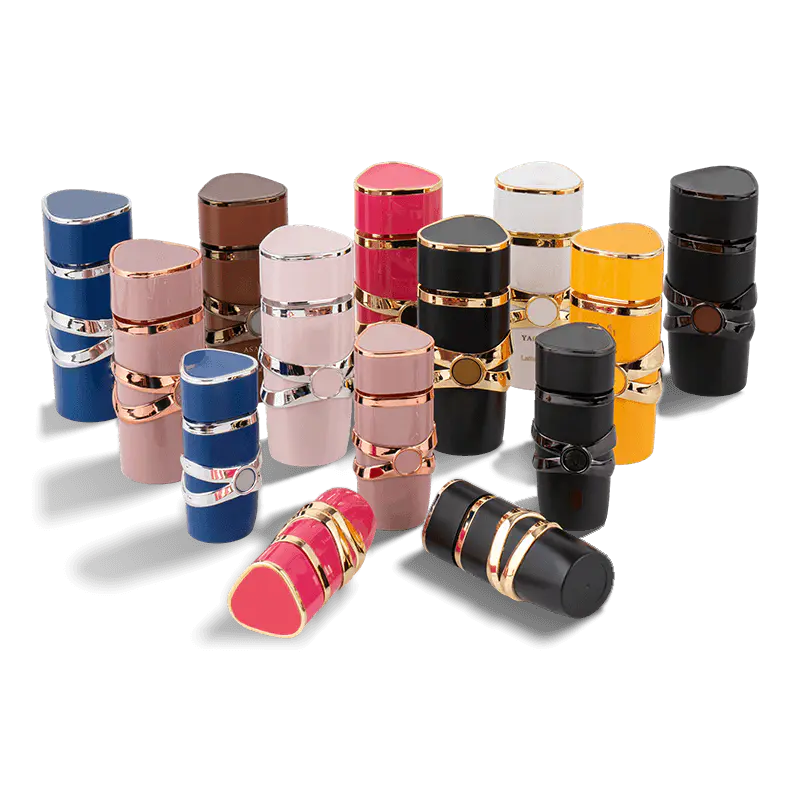 Round Luxury Empty 100ml Perfume Bottle
-
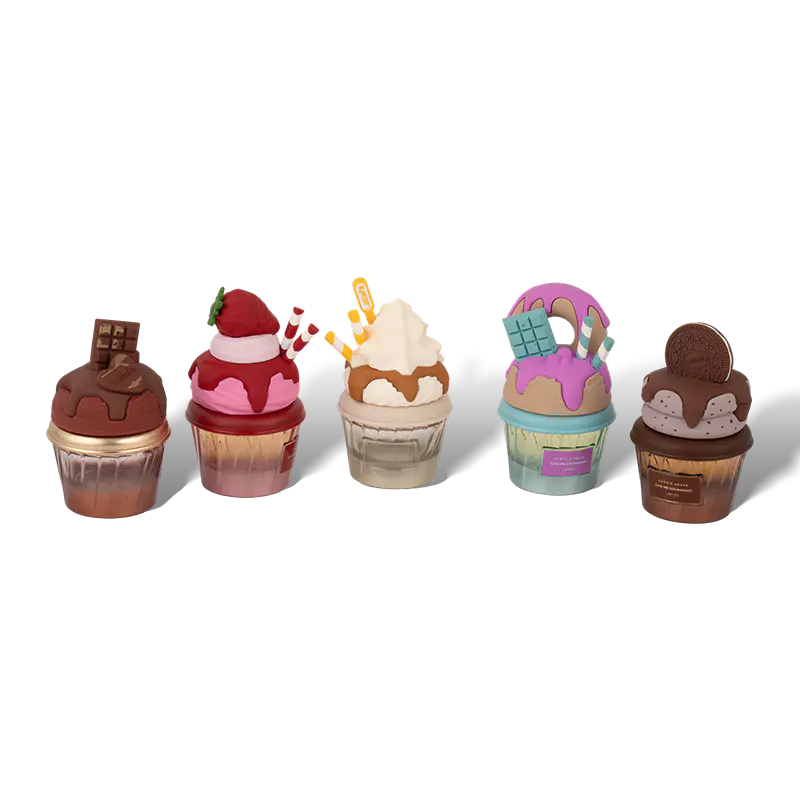 Luxury 100ml Round Perfume Bottle
-
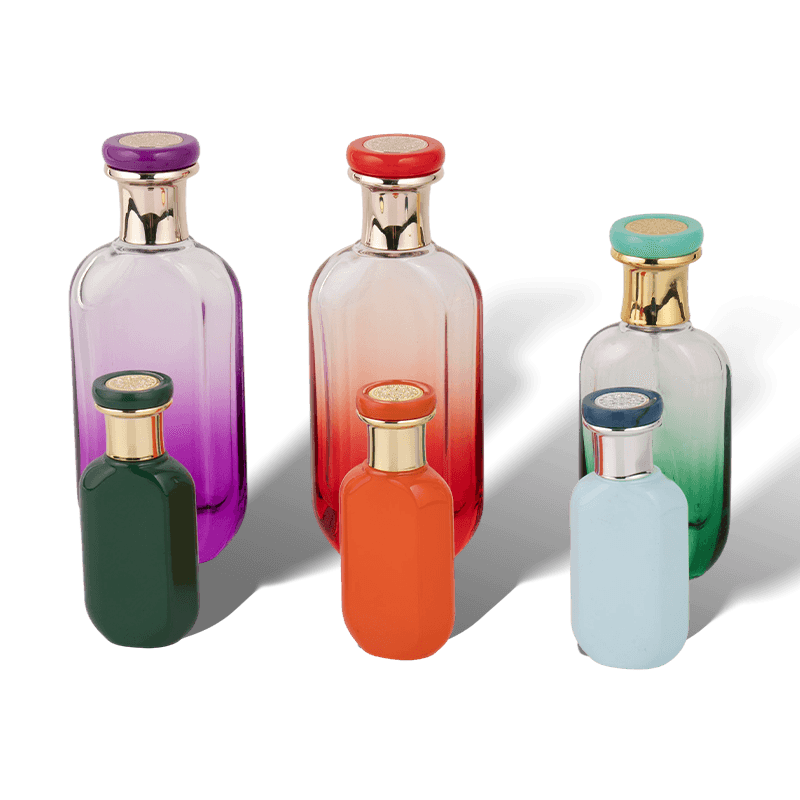
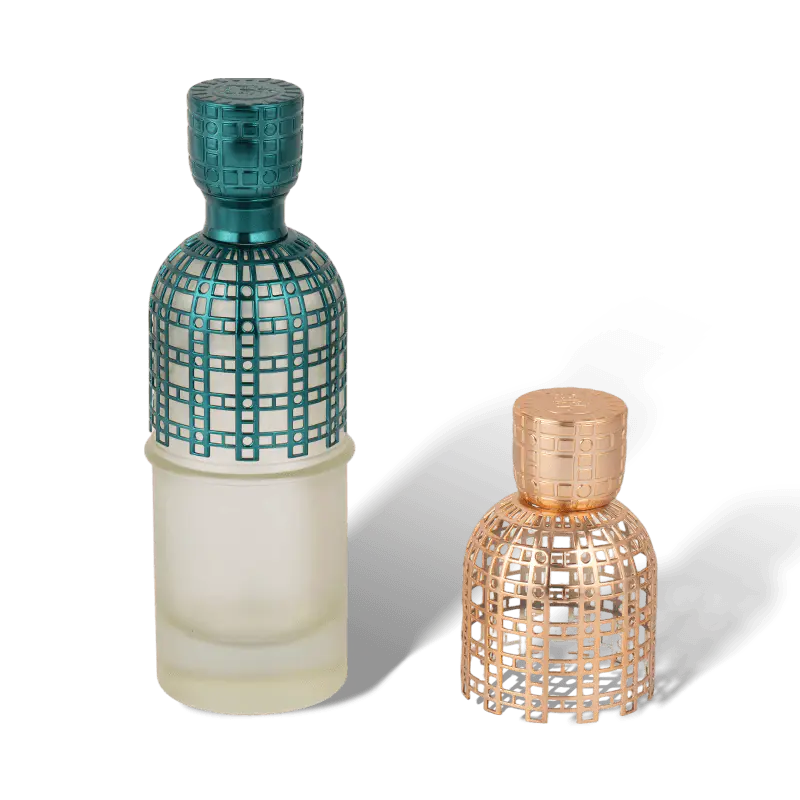 Gold 200ml/100ml/50ml/30ml Empty Arabic Dubai Glass Luxury Perfume Bottles
-
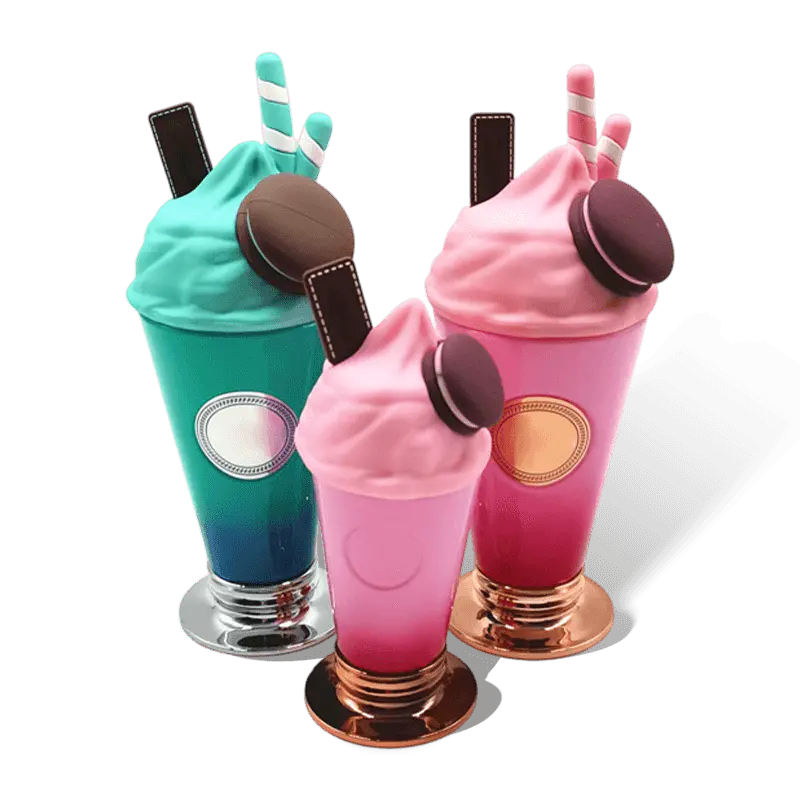 100ml Luxury Empty Glass Perfume Bottle
-
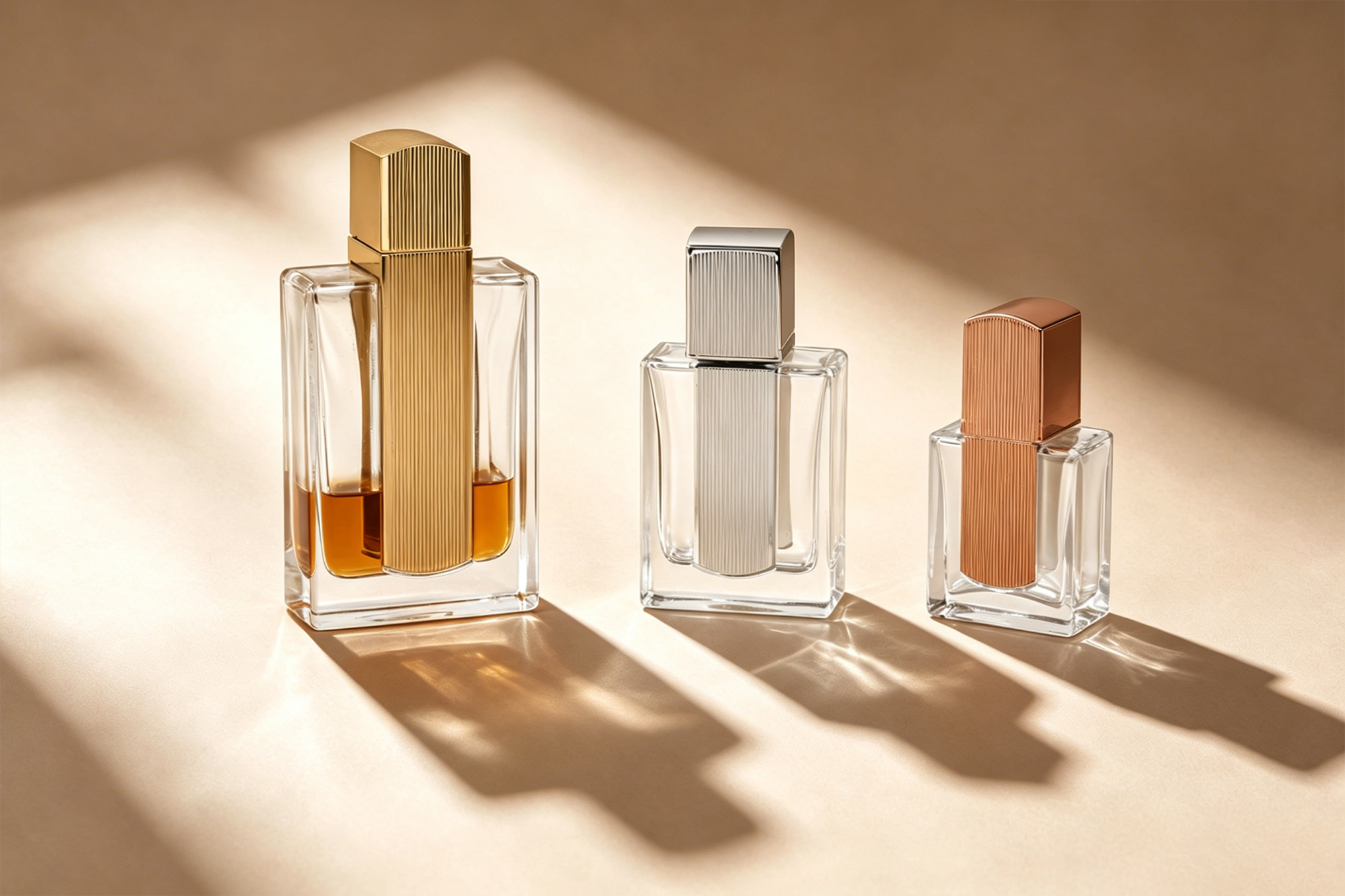
 Recyclable Rectangular 30ml/50ml/100ml Glass Perfume Spray Luxury Perfume Bottle
-
 Luxury glass perfume bottles 30ml/50ml/100ml/200ml
- +86 13968274500
- +86 13764345885
- ysgl@vip.163.com
- No. 10-18, Gaoxiakeng, Dongputou Village, Zhangqi Town