English
 中文简体
 Français
 Español
 عربى



30g Red Apple Cosmetic Packaging: A Distinctive Solution for Modern Skincare Brands
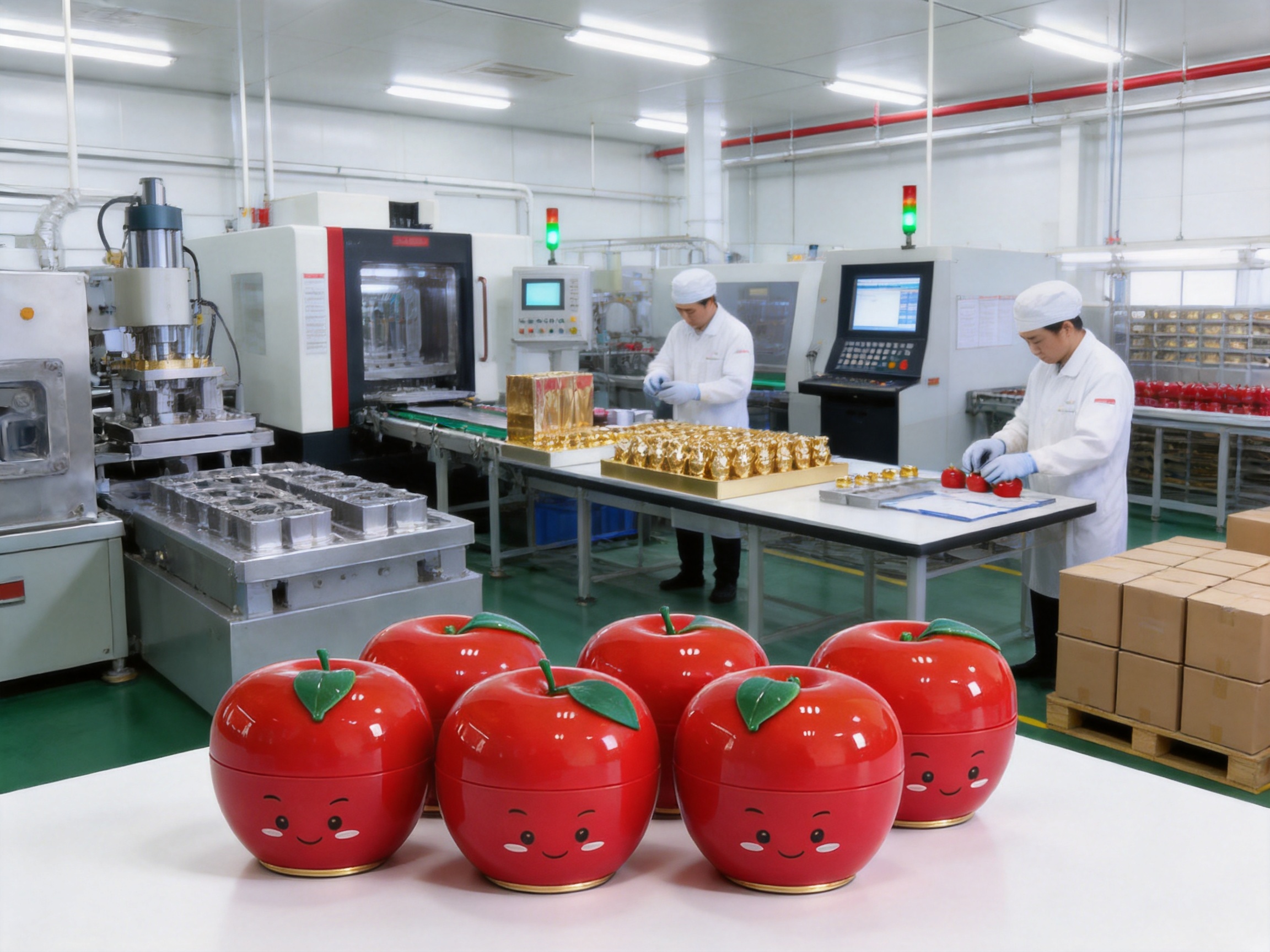
In the highly competitive skincare and personal care market, packaging must do more than contain a product. It must attract attention, communicate a brand personality, support convenient use, protect the formula, and create a memorable experience for the consumer. The 30g red apple cosmetic packaging bottle is designed around these requirements. With its bright red apple-inspired body, smiling facial expression, green leaf detail, compact capacity, and customizable surface, it offers a distinctive alternative to conventional round cream jars and standard cosmetic containers.
This fruit-shaped cream jar combines playful visual design with practical cosmetic packaging functions. It is suitable for face creams, hand creams, lip masks, children’s moisturizers, travel skincare products, gift sets, limited-edition launches, and other daily chemical applications. Its rounded form and strong color presence help products stand out in retail displays, online product photography, subscription boxes, and promotional campaigns.
Manufactured by DEPRAG Plastic Products Co., Ltd., the container reflects the company’s experience in cosmetic packaging design, mold manufacturing, plastic injection molding, printing, gilding, UV coating, product testing, and warehousing. The result is a packaging solution that supports both standard purchasing and brand-specific OEM/ODM development.
A Fruit-Inspired Concept for Memorable Skincare Packaging
Many cosmetic packages rely on familiar shapes such as cylinders, rectangular bottles, plain jars, or simple airless containers. These formats can be useful, but they are also widely used across the market. When multiple products have similar silhouettes, labels and colors may be the only elements separating one product from another.
The red apple container takes a different approach. Its fruit-shaped body immediately creates a visual association with freshness, friendliness, and approachability. The form is rounded and compact, while the bright red finish gives it a strong shelf presence. The green leaf placed on the top of the cap completes the apple-inspired appearance and creates a recognizable visual signature.
The design also incorporates a smiling face with eyes and blush details. This anthropomorphic expression gives the container a warm and approachable personality. Rather than presenting skincare as a purely technical or clinical activity, the package can help position the product as cheerful, comforting, and enjoyable. This is especially useful for brands targeting young consumers, family skincare users, children’s products, novelty gift markets, and social-media-driven beauty categories.
Packaging with a recognizable character can also support product memorability. A consumer may remember a product as “the smiling red apple cream” even before remembering the full brand name. That type of visual shorthand can support repeat recognition, retail browsing, and user-generated content.
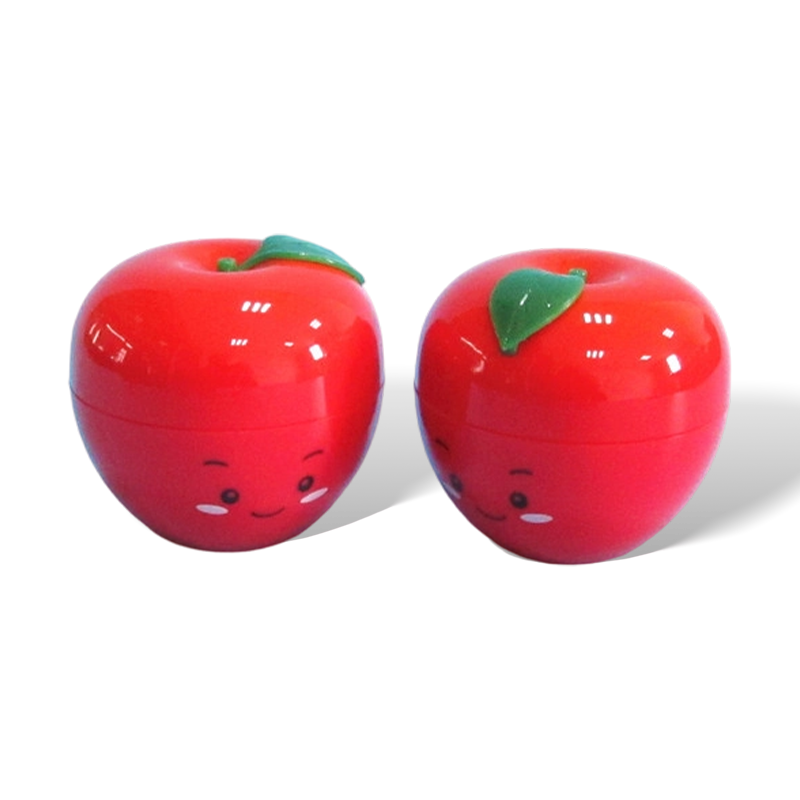
30g red apple ABS packaging cosmetic bottles
Key Product Characteristics
The 30g red apple cosmetic packaging bottle is designed as a compact cream container with a playful appearance and a polished surface. Its principal characteristics include the following:
| Feature | Product Advantage | Potential Application |
|---|---|---|
| Apple-inspired rounded shape | Creates a distinctive silhouette that differs from ordinary cream jars | Face cream, hand cream, lip mask, children’s skincare, gift sets |
| Bright red mirror-like finish | Provides strong visual impact and supports premium presentation | Retail launches, seasonal collections, promotional packaging |
| Green leaf cap detail | Completes the fruit concept and creates color contrast | Fruit-themed, playful, natural-inspired, or youthful brands |
| Smiling facial expression | Adds emotional appeal and character to the package | Fun skincare, children’s products, social-media-oriented brands |
| 30g nominal capacity | Balances portability, display value, and practical product volume | Trial products, travel sizes, hand creams, face creams, lip treatments |
| ABS/PP plastic construction | Supports a lightweight, durable, and customizable packaging format | Daily chemical packaging and cosmetic product development |
| OEM/ODM decoration support | Allows logos, illustrations, and surface treatments to be adapted | Private-label, custom-brand, limited-edition, and promotional projects |
The product information identifies the main material as high-quality ABS plastic and places the item within a broader ABS and PP cosmetic packaging range. Depending on the final structure and production specification, the exterior body, cap, inner components, or functional fittings may use different plastic materials. Brands should confirm the exact component material, compatibility requirements, and decoration specification during project development.
Why the 30g Format Is Suitable for Modern Cosmetic Products
Capacity has a direct influence on consumer convenience, shipping efficiency, trial behavior, and product positioning. A 30g package is large enough for a meaningful skincare experience while remaining small enough to carry in a handbag, cosmetic pouch, travel case, or promotional kit.
For hand cream, the size offers a convenient everyday format. For facial cream, it can serve as a trial or introductory size, a travel version, or a special-edition product. For lip masks and concentrated treatments, 30g can provide a practical balance between usage duration and portability. For children’s moisturizers, the compact size can make the product easier for parents to store and transport.
The spherical or rounded form also avoids the sharp corners associated with some rectangular packaging. This gives the product a soft appearance and can make it visually appealing when placed on a bathroom shelf, bedroom vanity, retail counter, or gift display.
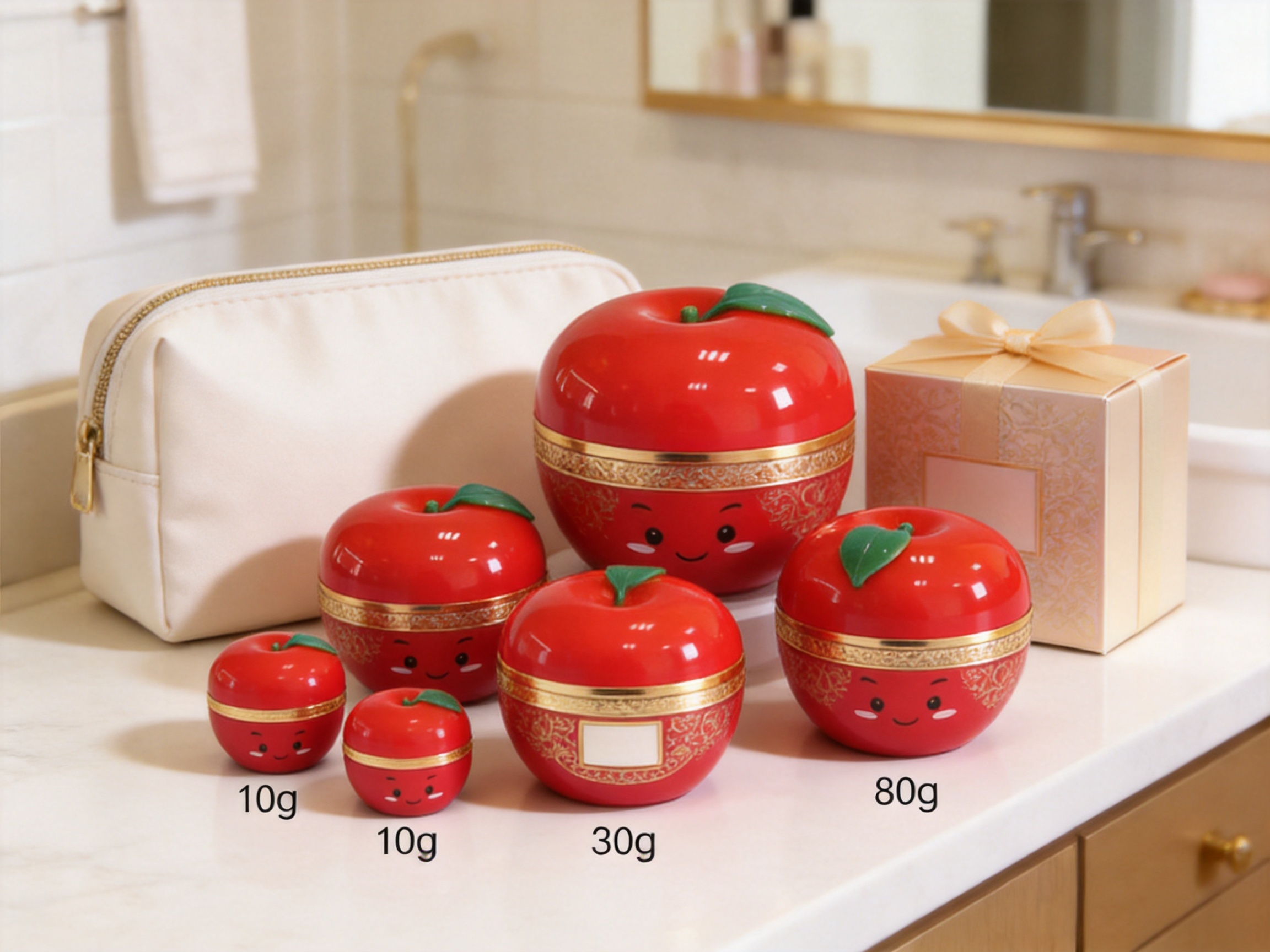
The product range can also support tiered product planning. In addition to the main 30g option, the supplied product information indicates 10g and 80g sizes. A 10g container can function as a trial, sampling, hotel, travel, or promotional format. An 80g version can be used for a larger cream, body lotion, or family-oriented product. By using a related visual language across several capacities, a brand can create a coordinated product family rather than relying on one isolated package.
Benefits for Product Launches
A 30g package can reduce the barrier to first purchase because consumers may be more willing to try a compact product than a large, higher-priced package. This is useful for new brands, unfamiliar formulations, seasonal products, and creative collaborations.
The compact format is also suitable for bundles. Brands can place several apple-themed containers in a gift box, combine the jar with other skincare products, or create a multi-fragrance collection. The vivid red appearance can help the product maintain a consistent visual identity across e-commerce images, point-of-sale displays, and influencer content.
From a logistics perspective, a smaller package generally offers flexibility for sample distribution and promotional fulfillment. Final shipping performance depends on carton design, component configuration, and product filling requirements, but a compact cosmetic container can be easier to incorporate into diverse sales channels.
Visual Advantages Over Conventional Cosmetic Containers
Traditional cosmetic packaging often emphasizes minimalism, clinical performance, or luxury through neutral colors and simple geometry. Those approaches remain effective for many brands, but they do not suit every target audience. The red apple jar provides a different competitive position based on character, color, and emotional communication.
Its bright red body can draw attention more quickly than a pale or transparent container when displayed among products with similar silhouettes. The green leaf provides a high-contrast accent, while the face gives the package a distinctive identity. This combination can help the container remain recognizable even when viewed from a distance or shown briefly in a digital advertisement.
The visual design also creates opportunities for storytelling. A brand can build a campaign around freshness, happiness, childhood memories, orchard-inspired ingredients, self-care rituals, or “good mood” skincare. The packaging itself becomes part of the marketing message rather than simply a passive holder for the formula.
Compared with plain jars, the apple shape offers a stronger novelty factor. Compared with rigid luxury packaging made from glass or metal, the plastic format can provide a lighter and more impact-resistant alternative. Compared with ordinary single-color plastic packaging, the red-and-green combination and facial details provide a more developed visual concept.
These advantages do not mean that the product is appropriate for every cosmetic category. A highly clinical dermatological product or a restrained luxury line may require a different visual language. However, for playful, approachable, seasonal, children’s, youth-oriented, or giftable skincare, the apple package provides a clear differentiation strategy.
Surface Finish and Shelf Impact
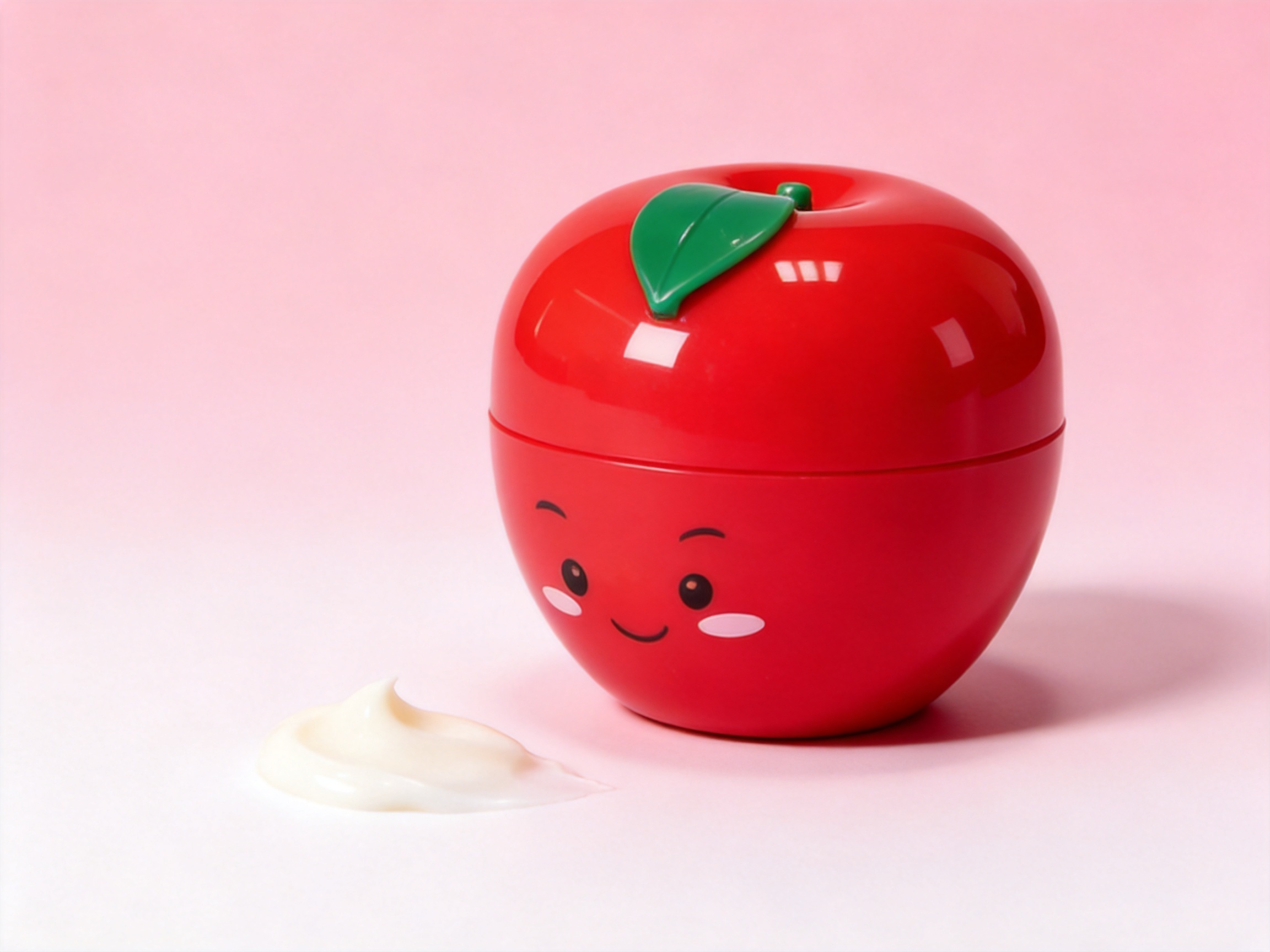
The product is described as having a bright red, high-gloss, mirror-like finish. A polished surface can increase perceived product value by creating smooth reflections under retail lighting and studio photography. It can also make the red color appear more saturated and energetic.
Glossy surfaces are particularly effective when the package is photographed for online stores. Highlights and reflections can emphasize the rounded apple form, while the green leaf creates a contrasting detail at the top. When properly controlled during production and inspection, the finish can contribute to a consistent appearance across a production batch.
Surface decoration can further strengthen brand recognition. The supplied customization options include silkscreen logo printing, gold foil stamping, and personalized illustrations. A simple logo may be placed on the front of the apple, while a small illustration or seasonal message can be used for a limited release. Gold foil can introduce a premium contrast against the red body, while printed artwork can support children’s collections or themed campaigns.
The final choice of decoration should take into account the curvature of the package. Rounded surfaces may require careful artwork preparation, printing alignment, ink selection, curing control, and inspection. DEPRAG’s integrated production capabilities allow these factors to be considered as part of the packaging development process rather than treated as separate operations.
Decoration Options for Different Brand Positions
For a youthful and playful brand, bright printed graphics, expressive characters, or colorful illustrations can reinforce the product personality. For a premium seasonal product, gold foil, restrained typography, and a carefully selected emblem can create a more elevated appearance. For a children’s product, simple shapes and friendly illustrations may improve approachability. For a natural-inspired line, leaf motifs, orchard themes, or botanical artwork can build a connection between the container and the product story.
Decoration is not limited to visual appeal. It can also help distinguish variants. For example, a brand may retain the red apple body while using different printed facial expressions, cap details, or label colors for different formulas. This allows the range to remain coordinated while giving each item its own identity.
Material and Functional Considerations
ABS is widely used in cosmetic packaging because it can provide a smooth surface, good rigidity, and a suitable base for decorative finishing. The material is associated with a solid hand feel and can help the container resist ordinary handling during storage and use. The supplied product information also emphasizes shock resistance, smoothness, and sealing performance.
PP is another important material in cosmetic packaging and may be used for compatible inner components, closures, or related product versions. PP is valued in many packaging applications for its lightweight nature and chemical resistance. Because the listed product category includes both acrylic and PP cosmetic packaging, brands should request a detailed component specification when evaluating a particular container.
Material selection must always be matched to the formula. Before mass production, brands should confirm compatibility with oils, alcohols, active ingredients, preservatives, fragrances, emulsions, and other formulation components. Testing should also consider filling temperature, storage conditions, transportation, and expected shelf life.
The package is intended to provide a protective barrier between the skincare formula and the external environment. A well-fitted closure can help reduce exposure to air, dust, and external contamination during normal storage. Actual protection depends on the complete packaging system, including the jar body, lid, inner seal, filling method, closure torque, and product formulation.
Practical Compatibility Testing
A professional packaging evaluation may include filling the actual formula into production-intent samples and observing the package over an appropriate period. Brands can examine color changes, swelling, cracking, stress marks, leakage, odor transfer, surface deformation, decoration adhesion, and closure performance.
For products containing volatile fragrances, essential oils, high concentrations of oils, or aggressive solvents, compatibility evaluation is particularly important. The final package should be selected based on laboratory evidence rather than appearance alone.
DEPRAG’s technical support and product testing capabilities can help customers move from a creative packaging concept toward a more reliable production specification. The company’s role is not limited to supplying an empty container; it also supports development activities associated with cosmetic and daily chemical packaging.
Manufacturing Strengths Supporting Consistent Production
The appearance of a fruit-shaped cosmetic package depends on more than the original design file. A successful production program requires accurate mold construction, stable injection molding, controlled decoration, reliable assembly, and systematic inspection. DEPRAG Plastic Products Co., Ltd. provides an integrated manufacturing process covering product research and development, design, mold manufacturing, plastic injection molding, blow molding, gilding and printing, UV coating, testing, and warehousing.
This broad process structure can simplify communication between design and manufacturing teams. When a supplier understands both the creative objective and the technical requirements, it can help identify potential issues before mass production. These may include draft angles, wall thickness, parting lines, assembly tolerances, cap fit, decoration areas, and surface-finish limitations.
Product Research and Development
Product research and development forms the foundation of a successful custom packaging project. The supplier can assess the proposed shape, capacity, materials, closure structure, and decoration requirements. For a rounded apple package, development work may focus on achieving the intended silhouette while maintaining practical manufacturability and sufficient structural strength.
R&D can also support size extensions. If a brand wishes to use the same design language for 10g, 30g, and 80g versions, each size must be evaluated for proportion, stability, usability, and production efficiency. A larger package may require a different internal structure, while a smaller package may need special attention to decoration scale and filling accuracy.
Mold Manufacturing
Mold quality has a direct impact on the appearance and repeatability of injection-molded cosmetic packaging. The mold determines key elements such as external geometry, surface details, alignment, and part separation. For a product with a rounded fruit shape and a visible facial expression, accurate mold construction is important for preserving the design intent.
A well-developed mold can help support stable dimensions and consistent assembly. It can also reduce the risk of visible defects such as uneven surfaces, excessive parting lines, incomplete details, or inconsistent wall sections. Mold manufacturing in-house or within an integrated production system can improve development coordination and shorten communication paths.
Plastic Injection Molding
Injection molding is suitable for producing repeatable plastic components at commercial volumes. The process requires control of material preparation, injection pressure, temperature, cooling, cycle time, and ejection. For high-gloss red parts, process stability is important because surface variations can be visible under strong lighting.
Consistent molding can support uniform color, shape, gloss, and dimensional performance across a production run. It also helps maintain the fit between the body, cap, leaf detail, and any inner component. Process parameters should be established according to the selected material and mold design, with appropriate inspection during production.
Printing, Gilding, and UV Coating
Cosmetic packaging often requires more than molding. Logos, decorative illustrations, metallic effects, and protective surface treatments may all be part of the final package. DEPRAG’s stated capabilities include gilding and printing as well as UV coating.
Silkscreen printing can be used for logos, words, facial details, or simple artwork. Gold foil stamping can provide a metallic accent that contrasts with the red surface. UV coating can be used as part of a surface treatment strategy, depending on the desired gloss, protection, and visual effect.
Each decorative process requires appropriate adhesion, alignment, curing, and appearance checks. Curved packaging presents additional challenges because artwork must follow the surface accurately. By coordinating molding and decoration, a supplier can better assess how a graphic will sit on the final package.
Quality Control and Production Reliability
Quality control is especially important for cosmetic packaging because appearance strongly influences consumer perception. A small scratch, color difference, printing shift, flash mark, or cap misalignment may be more noticeable on a high-gloss, brightly colored package than on a simple matte container.
Typical inspection considerations for the red apple packaging may include:
1. Visual inspection of the red surface for scratches, sink marks, contamination, uneven gloss, and color variation.
2. Dimensional inspection to verify that the body, cap, leaf detail, and inner parts remain within approved tolerances.
3. Closure testing to evaluate fit, opening and closing behavior, and resistance to leakage under appropriate conditions.
4. Decoration inspection to check logo position, printing clarity, foil adhesion, illustration alignment, and surface durability.
5. Material and component verification to ensure that production parts correspond to the approved specification.
6. Packaging and warehousing inspection to reduce damage during storage and transportation.
The exact inspection plan should be agreed upon during project development. Samples approved by the buyer can serve as a visual and dimensional reference for production. A clear approval process helps reduce misunderstandings when a package includes multiple colors, decorative elements, and assembled components.
DEPRAG’s stated production scope includes product testing and warehousing. These capabilities support a more complete supply chain, from initial development through finished-product storage. For customers purchasing cosmetic containers in wholesale quantities, coordinated warehousing can also assist with production scheduling and shipment preparation.
Customization for OEM and ODM Cosmetic Brands
The red apple container can be used as a stock-inspired design or as the starting point for a customized packaging project. DEPRAG supports OEM and ODM services, including custom logo silkscreen printing, gold foil stamping, and personalized illustrations.
OEM development is useful when a brand wants to maintain a proven package structure while applying its own identity. The brand may select the apple format, specify a color, provide a logo, choose a decoration method, and define the filling product. ODM development provides broader opportunities to modify the visual concept, capacity, components, artwork, or mold design.
Branding Possibilities
A skincare brand can place a centered logo below the facial expression, use a small emblem on the back, or print product information around the lower area of the container. A limited-edition collection can feature seasonal artwork, special messages, or alternate expressions. A children’s line can use simple illustrations, while a premium hand cream can combine the red body with restrained gold decoration.
For private-label projects, the package can help a new brand establish a recognizable identity without requiring a completely conventional jar. For established brands, it can serve as a special campaign package, holiday product, promotional item, or social-media-focused release.
Artwork and Technical Preparation
Before decoration begins, the brand should provide clear artwork files, color references, logo proportions, placement requirements, and packaging text. The supplier can then prepare production artwork based on the actual printable area and the curvature of the container.
Because the body is rounded, the visible front area should be carefully defined. The facial features and logo should not interfere with opening points, seams, or areas that may be covered by the cap. For multi-color printing, the brand should confirm color standards and acceptable tolerance ranges in advance.
Custom projects may also require confirmation of minimum order quantities, sample charges, mold costs, decoration costs, lead times, filling compatibility, and shipping arrangements. These commercial and technical details should be finalized before mass production.
Applications Across Skincare and Daily Chemical Categories
The creative design makes this container suitable for a wide range of products. Its primary application is cream-based skincare, but the final use should be determined by formula compatibility and filling requirements.
Face cream is a natural application because the package communicates softness, care, and daily use. The 30g capacity can suit a travel facial cream, introductory product, or limited-edition moisturizer.
Hand cream is another suitable category. The compact format can fit in a handbag, desk drawer, school bag, or gift set. The friendly face and bright color can make an ordinary hand-care routine feel more cheerful.
Lip masks and intensive lip treatments may also benefit from the small capacity and playful silhouette. Brands can use the apple concept to connect with fruit-inspired flavors, fragrance themes, or seasonal gift programs.
Children’s moisturizers can use the approachable facial expression to reduce the intimidating feeling sometimes associated with personal care. Parents remain the decision-makers, so the formula, safety information, closure performance, and labeling must remain appropriate for the intended product.
Body creams and lotions may use the larger 80g version referenced in the product information. The 10g option can be used for samples, hotel amenities, event giveaways, or trial kits. Together, these capacities can support a complete product ladder.
| Product Category | Recommended Packaging Role | Marketing Direction |
|---|---|---|
| Face cream | Travel, trial, seasonal, or boutique skincare format | Comforting daily care and memorable design |
| Hand cream | Portable everyday container | Cheerful, giftable, and convenient self-care |
| Lip mask | Compact treatment or beauty accessory | Playful, youthful, and visually distinctive |
| Children’s moisturizer | Friendly family skincare package | Approachable character and easy recognition |
| Body lotion | Larger coordinated version | Fruit-inspired collection or family-size product |
| Promotional sample | 10g trial-size format | Sampling, events, subscription boxes, and gift-with-purchase |
Advantages for Wholesale Buyers and Brand Owners
Wholesale buyers typically evaluate more than the appearance of a cosmetic container. They also consider supply reliability, customization options, production capabilities, communication efficiency, and the supplier’s ability to support future product development.
One advantage of working with an experienced packaging manufacturer is the ability to discuss design, materials, molds, decoration, testing, and warehousing through a coordinated process. This can reduce the need to manage separate suppliers for each stage.
DEPRAG is located in Cixi, China, an area known for its developed plastic manufacturing industry. The company is positioned near the Hangzhou Bay Bridge and within approximately one hour of Ningbo’s Beilun deep-water port and Hangzhou Xiaoshan International Airport, according to the supplied company information. This location can support convenient transportation for raw materials, finished packaging, samples, and export shipments.
The company operates modern standardized factories and has an experienced research and development team, advanced manufacturing equipment, and a broad product portfolio. Its stated offering includes thousands of daily chemical packaging designs as well as customized mold development.
For a buyer comparing suppliers, these capabilities can be important because cosmetic packaging projects often evolve. A company may begin with a standard 30g package, then request a different capacity, new decoration, matching bottles, or a coordinated gift-box series. A supplier with mold, molding, decoration, inspection, and warehousing capabilities can be better positioned to support that evolution.
Comparing the Apple Jar with Alternative Packaging Formats
Compared with conventional cylindrical cream jars, the red apple container offers stronger visual differentiation and a more expressive personality. A cylindrical jar may be easier to stack or label, but it may not create the same immediate association with a fruit or character.
Compared with glass jars, the plastic format can reduce weight and may provide greater resistance to breakage during ordinary handling. Glass can deliver a substantial luxury feel, but it may increase shipping weight and require more protective packaging. The choice depends on the brand’s positioning, formula, sustainability objectives, and distribution method.
Compared with airless packaging, a traditional cream jar may have a different dispensing experience and barrier structure. Airless systems can be preferred for certain sensitive formulas, while jars can be appropriate for products designed for finger or spatula application. Brands should select the dispensing format based on formulation stability, hygiene requirements, consumer habits, and regulatory expectations.
Compared with plain white or transparent plastic containers, the red apple design offers a stronger ready-made visual concept. It can reduce the amount of graphic explanation needed to make the package recognizable. At the same time, brands should ensure that mandatory product information remains readable and that decorative choices do not interfere with labeling compliance.
Designing a Successful Product Experience
A memorable package should remain practical during everyday use. The rounded body should be comfortable to hold, while the cap should open and close securely. The facial design should remain visible from the main viewing angle, and the leaf detail should contribute to the concept without creating unnecessary interference during handling or packing.
The package can be incorporated into a larger consumer experience. A brand might use apple-shaped graphics on the outer carton, create a fruit-themed product name, add a matching spatula, or design a social-media campaign around the smiling face. The container can also serve as a decorative object after the product is finished, although any reuse should be determined by the package construction and cleaning requirements.
For e-commerce, the strong color and unusual silhouette can help the product remain recognizable in thumbnail images. For retail, the package can provide a clear visual anchor in a display. For gift sets, several red apple containers can create a playful and abundant presentation.
Recommended Development Process
A well-organized packaging project generally begins with a product brief. The brand should identify the formula type, target capacity, intended market, price position, target audience, decoration requirements, estimated order quantity, and desired launch date.
The next stage is sample evaluation. The brand can review the physical shape, color, gloss, cap fit, leaf detail, facial expression, and overall hand feel. If the package will contain a finished formula, compatibility samples should be filled and tested as early as possible.
Artwork approval follows the physical evaluation. The brand should confirm logo size, print location, color, foil effect, illustration details, and required product information. A production sample or decorated pre-production sample can help establish the reference standard.
Before mass production, the buyer and supplier should confirm the material specification, capacity, component structure, mold status, decoration process, inspection requirements, packing method, and delivery plan. Clear documentation reduces the possibility of changes after production has begun.
After mass production, finished goods should be inspected according to the approved criteria. The packaging should then be stored in suitable conditions and protected during transportation. DEPRAG’s warehousing and logistics support can form part of this final stage.
Frequently Asked Questions
What type of product is the 30g red apple container designed for?
It is primarily designed for creams and other semi-solid skincare products, including face cream, hand cream, lip mask, and children’s moisturizer. The final application should be confirmed through formula compatibility and filling tests.
What makes the package different from a standard cream jar?
The package uses an apple-inspired rounded shape, a bright red high-gloss appearance, a green leaf detail, and a smiling facial expression. These features create a stronger visual identity and a more playful consumer experience than a plain cylindrical or rectangular jar.
Is the capacity exactly 30 milliliters?
The product is identified as a 30g package and is described as approximately 30ml in the supplied information. Actual fill volume depends on the formula density and filling specification. Brands should confirm net content, overflow capacity, and filling conditions with the manufacturer.
What materials are available?
The product information identifies high-quality ABS plastic as the primary material and also references ABS/PP cosmetic packaging. The exact material of each component should be confirmed for the selected version. Formula compatibility testing is recommended before mass production.
Can the package be customized with a logo?
Yes. Available customization options include silkscreen logo printing, gold foil stamping, and personalized illustrations. The decoration method should be selected according to the artwork, surface curvature, desired appearance, and production volume.
Are other sizes available?
The supplied information identifies 10g and 80g options in addition to the main 30g size. The smaller version may be suitable for samples or travel, while the larger version may support body lotion or larger skincare products.
Can a brand create a completely new version of the design?
DEPRAG provides OEM and ODM support. A brand can discuss customized artwork, decoration, component details, capacity, and potentially customized molds. Technical feasibility, tooling, minimum order quantity, and lead time should be evaluated for each project.
Is the package suitable for children’s skincare?
The friendly design may be suitable for children’s skincare lines, but the suitability of the complete product depends on the formula, closure, labeling, safety requirements, and intended age group. Packaging appearance alone does not determine product safety.
How should a brand test the package before ordering?
The brand should evaluate physical samples, perform formula compatibility testing, inspect closure performance, review decoration adhesion, and assess the package under expected storage and transportation conditions. Production-intent samples are preferable for final approval.
What manufacturing services does DEPRAG provide?
According to the supplied company information, DEPRAG provides product research and development, design, mold manufacturing, plastic injection molding, blow molding, gilding and printing, UV coating, product testing, and warehousing. These capabilities support integrated cosmetic packaging development.
Where is the manufacturer located?
DEPRAG Plastic Products Co., Ltd. is located in Cixi, China. The company information states that it is near the Hangzhou Bay Bridge and within approximately one hour of Ningbo’s Beilun deep-water port and Hangzhou Xiaoshan International Airport.
Conclusion
The 30g red apple cosmetic packaging bottle offers a strong combination of visual differentiation, compact portability, customization flexibility, and plastic manufacturing practicality. Its bright red body, green leaf, smiling face, and rounded shape create an immediately recognizable package that can help skincare brands move beyond ordinary cream jars.
The package is particularly well suited to fun skincare, youthful beauty, children’s personal care, seasonal campaigns, gift sets, travel products, and social-media-friendly launches. Its 30g format can support trial and portable use, while the referenced 10g and 80g options provide opportunities for a coordinated product range.
Its competitive value is strengthened by DEPRAG’s integrated production capabilities. From product development and mold manufacturing to injection molding, printing, gilding, UV coating, testing, and warehousing, the company can support multiple stages of the packaging supply chain. OEM and ODM services also allow brands to adapt the container through logos, metallic decoration, custom illustrations, and related design development.
For brands seeking luxury cosmetic packaging with a more playful and emotional identity, the red apple container presents an attractive alternative to conventional skincare packaging. Final success depends on appropriate formula compatibility, decoration approval, quality standards, and production planning, but the concept provides a distinctive foundation for building a memorable cosmetic product.
References
1. Product specification and marketing information for the 30g red apple ABS cosmetic packaging bottle, supplied for this article.
2. DEPRAG Plastic Products Co., Ltd. company profile and manufacturing capability information, supplied for this article.
3. General principles of plastic cosmetic packaging design, material selection, decoration, and quality evaluation.
4. General packaging development practices for cosmetic formula compatibility, closure performance, transportation, and storage testing.
5. General principles of OEM and ODM development for personal care and daily chemical packaging.
Product: 30g red apple ABS packaging cosmetic bottles

-
 DP-A-021 50g/30g/20g Skin Whitening Cream Packaging Cosmetic Jars
-
 DP-A-009 Body Cream Jar 80ml Container 70ml Cosmetic Packaging Body Butter Plastic Jar
-
30g red apple ABS packaging cosmetic bottles
-
 DP-A-004 30ml/50ml/80ml/100ml/120ml High-end skincare packaging
-
 DP-A-018 Acrylic jars for whitening and anti-aging cosmetic creams
-
 1oz 30g empty PP plastic cream jars for skincare
- +86 13968274500
- +86 13764345885
- ysgl@vip.163.com
- No. 10-18, Gaoxiakeng, Dongputou Village, Zhangqi Town